By Sofia Oumoussa, University of Hawaiʻi at Mānoa
My name is Sofia Oumoussa. I was born and raised in Belgium and went through school in French. I am now a non-traditional student at the University of Hawaiʻi at Mānoa, majoring in journalism with a certificate in Peace and Conflict Studies. Before I came back to school full-time in Hawaiʻi, I worked as a private tutor through the pandemic, then as a substitute teacher across private schools in Honolulu, and as a French teacher at La Pietra. I am interested in Indigenous questions and how Indigenous communities hold onto memory, language, and peace in places that have tried to take all three from them.
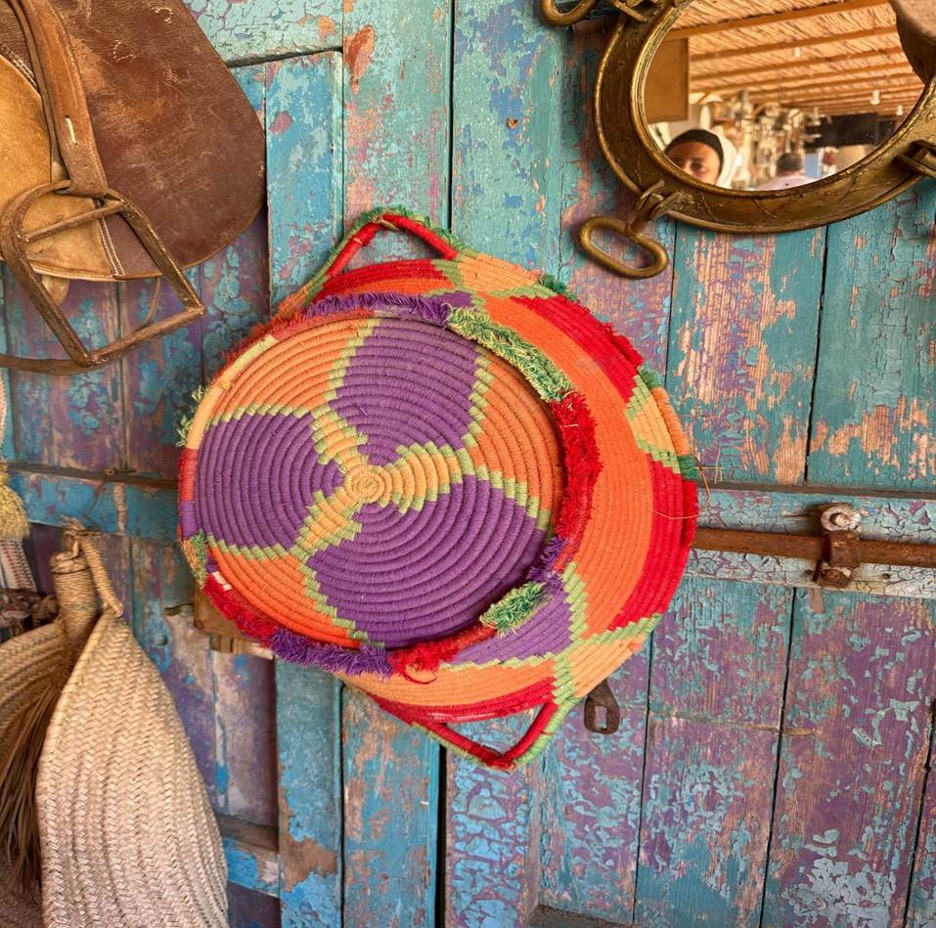
The colors of the Rif, woven by hand. This basket is one of hundreds of objects collected by a community member over decades to make sure his community’s material heritage would not disappear. El Boustan Museum & Café, Beni Chiker, Morocco. Credit: Sofia Oumoussa
On campus, I chair the Strategic Planning Committee for our Student Media Board and serve as the incoming president of our chapter of the Society of Professional Journalists. I am a staff reporter for The Mānoa Mirror, where I frequently publish articles that are UH-related. I also work part-time at UH’s Center for Oral History, where I have been learning the craft of interviewing while meeting wonderful like-minded people. In my free time I walk the trails in Oahu, love to discover new coffee shops, and recently started to be more interested in biohacking my body to improve my health. Growing up in Belgium, questions about Indigeneity were never part of the conversation. Only after moving to Hawaiʻi did I start to be exposed to these questions. It took me a trip across the world to finally ask myself the existential questions. My family is of Amazigh origins, from the Rif region, and this project is one of the most meaningful things I will do in my life, to capture the stories of the elders in the Rif and make sure they are preserved for the next generations.
My project is titled “Re-storying the Rif: Centering Imazighen Indigenous Oral History in Northern Morocco.” The Imazighen (Berber) communities of the Rif have oral traditions, including stories, songs, genealogies, and ecological knowledge, that have been passed down through generations in Tarifit, an Amazigh language indigenous to North Africa and spoken throughout the Rif region. As younger generations increasingly shift toward Arabic, French, and Spanish in many areas, some of these oral traditions face the risk of being lost along with the language and cultural knowledge they carry.
My research focuses on three communities in the eastern Rif: Beni Chiker (my mother’s community), Beni Ansar (a border community located four kilometers from the Spanish enclave of Melilla), and Yassinin (my father’s ancestral village). Each community preserves a different layer of memory, ecological memory, border and diaspora memory, and resistance memory dating back to the early twentieth century.
I will conduct semi-structured oral history interviews, record them with participants’ consent, and work to return those recordings to the communities themselves. By documenting and preserving these oral histories, I hope to contribute to safeguarding Indigenous knowledge and strengthening connections between past and future generations in the Rif.
My journey begins in Casablanca, where I land on May 30th after a flight from Honolulu. From there, I will drive north, stopping at the Royal Institute of Amazigh Culture (IRCAM) in Rabat and the University of Al Quaraouiyine in Fès — the oldest university in the world — before arriving in Nador, the mid-sized city in the northeastern Rif that will serve as my base for most of the trip. From Nador I will move between three communities at the heart of my research: Beni Chiker, Beni Ansar, and Yassinin. After the eastern Rif, I travel west through Al Hoceima, Chefchaouen, and Tanger, before returning to Casablanca and flying home in mid July.
There is a particular kind of knowledge that only becomes available when you conduct research in a place that is also “home”. I am not going to Morocco as an outside observer studying a distant community. My mother’s family is from Beni Chiker. My father’s family is from Yassinin. The elders I will sit with are not strangers. They are people who knew my grandparents, who spoke the language I grew up hearing at the kitchen table in Belgium without fully understanding what I was hearing.
Conducting research in this context has a value that no library, no archive, and no classroom can replicate. It forces a kind of accountability that outside researchers rarely face, when the community you study is also your community, you cannot extract and disappear. You are responsible for the people whose stories you carry. That responsibility makes you a better researcher, a more honest listener, and a more careful writer.
By conducting this research, I expect and hope to find the missing piece. When you grow up in the diaspora, you are in a way unrooted from where you were meant to live. This trip is my attempt to hear stories that were never written anywhere, that exist only in the memory of the people who lived them. I also hope to see my father touched by all of this. He always called his community “people in the middle of nowhere.” I want to prove to him that people care. That someone came all the way from Honolulu to listen. That his community is not in the middle of nowhere but it is at the center of something worth knowing.
I understood that peace happens the day we understand where we come from.
What I am apprehensive about is not doing justice to the stories I will be trusted with. Not taking enough pictures, videos, and recordings. And the time it will take to edit all of it when I get back.

