By Angelina Kwan, University of California San Diego
Hello everyone! Yesterday was my last day at the hospital and it was bittersweet to say goodbye to everyone, but I am excited to travel before heading home to San Diego. The past two and a half months spent studying and exploring while at Wakayama Medical University in Japan have been truly unforgettable. Though my time in Wakayama is coming to an end, I am grateful for the kindness of the people I have met, the incredible experiences, and the new opportunities I have gained. Everything from seeing summer fireworks festivals in the countryside, watching robotic surgeries, and traveling with friends have become core memories.
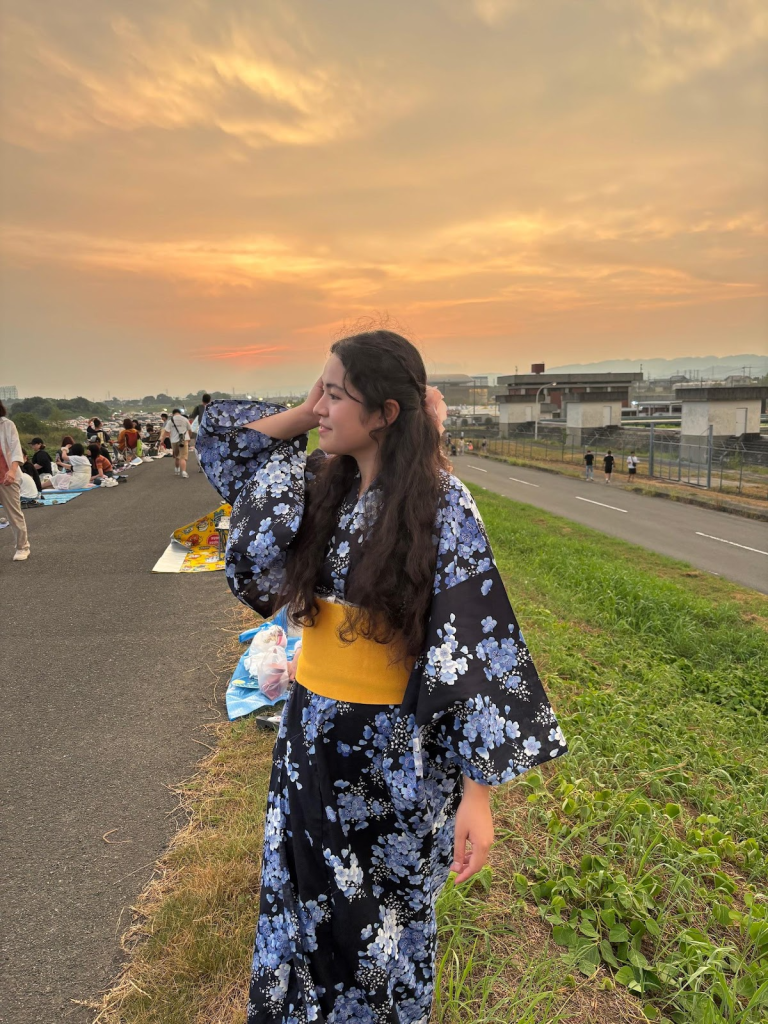

At a summer fireworks festival in the countryside of Wakayama
Since my last blog post, I have modified my research goals, completed my project, and submitted my abstract to a conference. With the help of my mentors, my research project was narrowed down to compare three robotic surgical methods used in total knee replacement surgery for advanced osteoarthritis. Robots are used in total knee arthroplasty (also called total knee replacement surgery) to assist in the bone resectioning process where damaged bone is removed, procedural planning where dimensions or materials can be selected, and the placement of the knee implant which comprises the new joint. Two popular robots, the ROSA model by Zimmer Biomet and the MAKO robotic system by Stryker, differ in their bone saw attachment and preoperative planning methods. The ROSA system offers two preoperative planning options: imageless (no imaging required) and x-ray-based (using flat x-ray scans), while the MAKO system offers only CT-based planning (using computed tomography scans). A retrospective cohort study was conducted to compare the accuracy of implants placed using one of three methods: ROSA imageless, ROSA x-ray-based, or MAKO CT-based planning option. It was initially hypothesized that the MAKO CT-based option would be the most accurate because the robot itself offers haptic feedback to prevent human error intraoperatively while the ROSA robot does not. However, the ROSA imageless and MAKO CT-based options demonstrated comparable accuracy which was significantly greater than the ROSA x-ray-based option. This suggests that planning method, rather than bone saw modality, is the primary influencing factor in implant placement accuracy. This was an interesting finding as it suggests limitations in the translation of 2D x-ray images to 3D space and potential for improvement.
Applying the anatomy knowledge that I gained while working on a knee study using animal models in San Diego was so useful in understanding the clinical applications of this research. While my research project was mostly imaging analysis, I also had the incredible opportunity to watch several operations performed using each of the methods included in the study.
Researching abroad has helped me grow as a person by learning to be adaptable in complex environments such as rural hospitals. I have seen myself gain confidence in my communication skills, and it is my goal to continue to improve my ability to explain complex topics in simple terms. I have such gratitude for everyone from the patients who were so welcome to the idea of letting a student watch their medical exam to the nurses, residents, and medical students who were so kind and helpful. The biggest takeaway from my experience abroad is that learning is a lifelong journey and I have just as much to learn from the patients as I do from the healthcare staff. In the future, I hope to use these skills to better serve the diverse community in my hometown.
Thank you to the Tyler Center, my mentors, and the UCSD Undergraduate Research Hub for your support of my academic journey! This is just the beginning!
 HSF House Blogs