As my research comes to a close, I can only reflect on my work and what I hope it will achieve. The impact of my research lies in its ability to confront and reframe how we as individuals and as a society think about mortality, decay, and the sacredness of impermanence. My project draws from traditions of funerary imagery, specifically Japanese kusozu painting and Italian memento mori, along with the development of fictional belief systems to probe uncomfortable truths about death and decomposition. In doing so, I am not only creating artworks that exist as aesthetic or narrative objects, but also contributing to a larger conversation in contemporary art, one that asks: how do we situate death in our cultural, spiritual, and psychological landscapes?

Through material exploration, I have discovered a kind of pleasure in working with forms and textures that signify decay and the dissolution of the body. The very act of making these works, whether through painting, sculpture, or ritualized object creation, becomes a way of acknowledging dread and unease while also transforming them into sites of beauty, reverence, and even joy. I see this as a radical intervention in a culture that often denies, hides, or sanitizes the reality of death. By visually and materially engaging with decay, I offer audiences a chance to encounter awe rather than avoidance. This shift from fear to reverence has the potential to affect how viewers approach not only mortality but also the transient nature of their own lives.
A key theme within my work is the dissolution of identity. By depicting decomposition as sacred, I emphasize the moment where individuality and ego cease to matter, where the responsibility of “being a human” as we understand it falls away. In place of individual identity, there is transformation into matter, into memory, and into myth. This perspective resists a purely anthropocentric view of life and death, instead suggesting a continuum that places the body within larger cycles of ecology and spirituality. My academic voice contributes to contemporary conversations in visual art and death studies by emphasizing this tension between dread and awe, and individuality and dissolution.
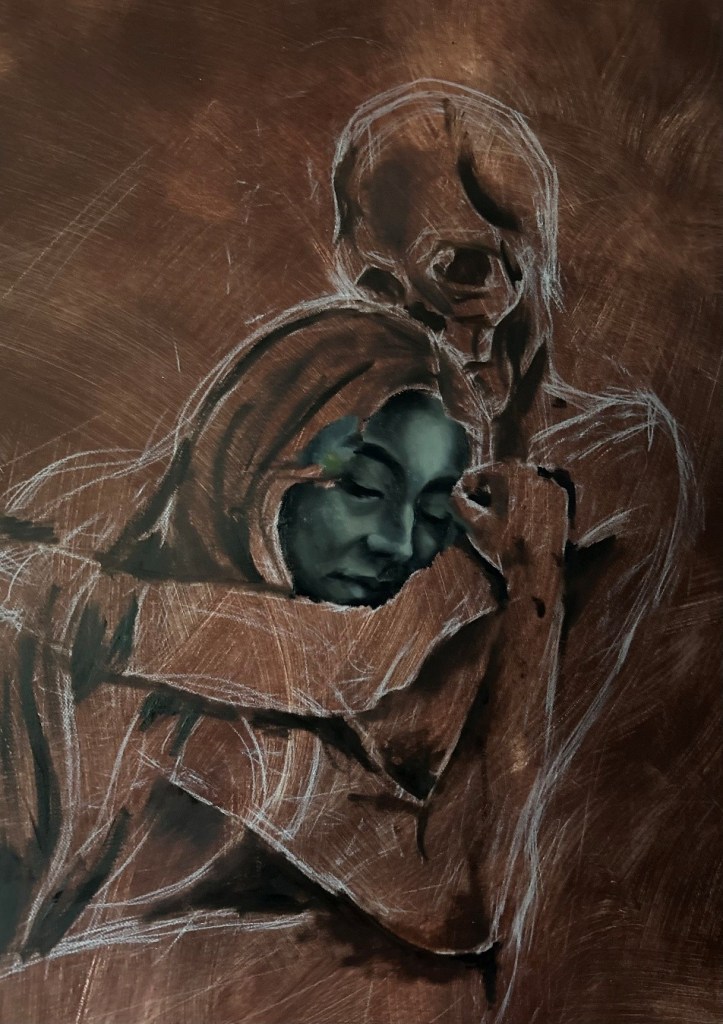
The potential impact of my research on others is both emotional and intellectual. On one hand, viewers may feel discomfort, confronted with imagery that resists the polished, distant ways death is typically presented in American funerary practice. On the other hand, they may feel liberated in recognizing that decay, far from being something to fear, can be understood as a sacred, transformative process. My work invites audiences to expand their capacity for reverence in spaces where they may expect only horror or grief. For some, this may offer a way to process personal loss; for others, it may provide new frameworks for considering the metaphysical weight of impermanence. In this way, my research creates a ripple effect, broadening the conversation around death to include not only mourning but also curiosity and reverence.
As I move forward with this research at Florida State University, I am excited to continue building a visual language that integrates anatomical accuracy and symbolic imagery. I aim to refine recurring motifs that embody the sacred aspects of decomposition in my paintings. I am also eager to further immerse myself in interdisciplinary studies, bringing together art history, anthropology, and religious studies to deepen the conceptual grounding of my practice.
Beyond FSU, I see myself exploring the field of funerary arts and mortuary science more directly. This summer research experience has shown me the profound resonance that exists between creative practice and mortuary work. Both deal with ritual, both shape how death is understood by the living, and both require sensitivity to the emotional weight of mortality. I am particularly interested in how these fields overlap, specifically how art can inform the rituals of death care, and how death care can in turn shape artistic practice.
This research experience has also set me up with a stronger foundation of discipline, clarity, and academic framing for my work. It has forced me to articulate not only what I am making, but why it matters, and how it contributes to larger intellectual and cultural conversations. That ability to situate my voice within the broader field will be essential as I pursue further study and professional opportunities. I am energized by the possibility of pursuing graduate study in funerary arts to expand the reach and depth of my practice.
Ultimately, the impact of my research is measured not just in the objects I create but in the conversations they provoke. My work aims to shift dread into awe, silence into dialogue, and denial into reverence. By continuing this exploration at FSU and beyond, I hope to contribute to a culture more willing to confront the inevitability of death and to find in it not only unease but also beauty, transformation, and a profound sense of the sacred.
 HSF House Blogs