I am currently in the stage of data analysis, where the long hours of designing the experiment, fieldwork, and navigating setbacks begin to take shape as meaningful results. My research examines the intersection of pregnancy, immunity, and parasitic burden in Atlantic stingrays (Hypanus sabinus), offering a unique opportunity to understand stress physiology across vertebrates more broadly. Reproduction is one of the most costly metabolic processes in nature, and in sharks and rays it is especially demanding, pregnancy often results in suppressed immune function and greater vulnerability to infection. In coastal ecosystems, more than half of marine animals are infected with parasites, a problem that is becoming more severe with climate change. By focusing on the physiological stress caused by parasitic accumulation during pregnancy, my work not only deepens our understanding of stingray biology but also contributes to conservation by informing protocols to protect reproductive animals in aquaria, research facilities, and natural environments.

The impact of this research lies in its ability to bring attention to dynamics that are often overlooked. Parasites are rarely considered in studies of reproduction, even though they are ever-present ecological players. Stress and reproduction are typically studied independently, despite the fact that they interact constantly. My work highlights the need for a more interdisciplinary approach, one that bridges parasitology, physiology, ecology, and conservation. This not only benefits stingray conservation but also provides a framework for understanding how environmental stressors affect reproduction and survival across species. More broadly, it highlights the importance of maintaining healthy environments so that animals can thrive without the added burden of ecological stressors.

This research also reflects the kind of scientist I want to be. I believe science should serve both knowledge and community, expanding our understanding while also benefiting the animals who depend on ecosystems. By studying these hidden pressures, I am contributing to a more holistic understanding of animal health, and my academic voice adds to a larger conversation in my field about resilience, overlooked stressors, and conservation in a changing world. My work may ultimately affect those around me by supporting conservation efforts, helping aquaria and research facilities care for animals more effectively, and raising awareness about the invisible ecological challenges wildlife face.

My academic journey at Florida State University has also taken me into another project within the past year, one that looks not at physiology but at social behavior: the study of cooperative courtship in the Lance-tailed Manakin (Chiroxiphia lanceolata). My project, “Networking to Rise, Rule, or Learn: A Study of Social Interactions in the Lance-tailed Manakin”, examines how social connectivity varies with status and whether these interactions influence progression into dominance. This work adds to the larger understanding of how cooperation and social networks shape population dynamics, reproductive success, and hierarchy in animals.
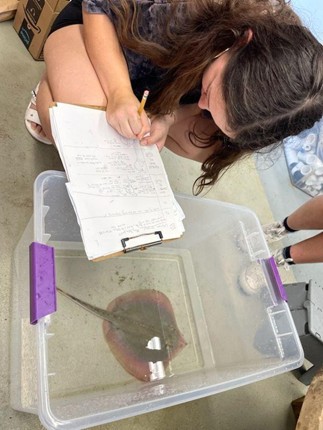
Looking ahead, my next steps are to translate both of these projects into publications. I am excited to begin writing two papers: one based on my IDEA Grant research with stingrays in the Grubbs lab, and one on manakins in the DuVal lab. These represent very different questions, but both reflect my deep interest in how animals interact with their environments and with each other. Beyond writing, I will also be preparing to apply to graduate programs in ecology and evolution. I want to join a lab where I can continue to explore animal behavior and physiology, ultimately working toward a Ph.D. My long-term goal is to become a professor who not only conducts meaningful research but also mentors the next generation of scientists.
This research experience has set me up for these next steps in profound ways. It taught me how to conduct an experiment from start to finish, including how to troubleshoot when faced with setbacks. It forced me to confront self-doubt and helped me gain confidence in my ability to design studies, contribute ideas, and see them through to completion. It was not easy, but overcoming the hurdles gave me persistence, patience, and creativity—the qualities that define a true researcher. In the end, the impact of my research goes beyond stingrays or manakins. It contributes to conservation and animal care, highlights overlooked aspects of biology, and adds to the larger academic dialogue on resilience in the face of stressors. It reflects my love for the natural world and my belief that science should be both rigorous and compassionate. To me, research is not just about knowledge—it is about empathy, about understanding the lives of animals so that we may better protect them and hopefully learn more about ourselves in the process.

I would like to thank the Center for Undergraduate Research and Academic Engagement for recognizing the potential in this project, and Dr. Jim Lee for providing the funding to make it possible. I am especially grateful to Annais Muchett-Bonilla for taking me under her wing and guiding me through the process of research; her mentorship has been truly inspiring. I also thank Dr. Dean Grubbs for overseeing this project in his laboratory, as well as everyone at the FSU Coastal & Marine Laboratory who contributed to its success. Finally, I am deeply thankful to my mom and dad for their constant support throughout my academic journey—I could not have come this far without them.
I will be presenting at the Florida State University’s President’s Showcase on Thursday, October 23rd and invite all who are interested in my work to come out and see the results of this research. If you wish to follow my academic journey or learn more about what I do, please click the link below to gain access to my socials and posters.
 HSF House Blogs