This summer has been a whirlwind between classes, internships, and research. Although there were many challenges, I am truly grateful for the experience the IDEA grant program has given me.
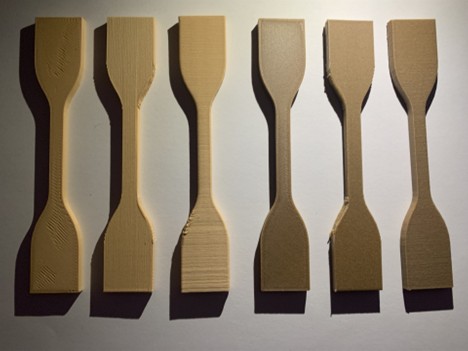
To recap, my research project aimed to provide new knowledge on the mechanical behavior of 3D printed wood-plastic composites in the context of the existing body of literature and socio-environmental sphere. By systematically investigating how print orientation, wood fiber content, moisture exposure, and ramped loading interact to shape the orthotropic mechanical behavior of 3D-printed wood–PLA composites, this study aims to bridge a critical gap in the existing literature. Through careful specimen preparation, rigorous adherence to ASTM standards, and robust modeling of moisture and fatigue effects, this research aspired to produce data that not only deepens theoretical understanding but also informs practical applications for sustainable, bio-based materials in construction and design. Ultimately, the insights gained here will hopefully contribute to the development of resilient, climate-adaptive composites, helping engineers, manufacturers, and designers push wood plastic composites closer to real-world structural viability and sustainable innovation.

This project attempted to contribute meaningful advancements to both academic research and practical applications. Researchers and engineers will gain valuable experimental data clarifying how moisture and stress affect the orthotropic behavior of wood-plastic composites. These insights can refine constitutive models, inform accurate finite element analysis (FEA), and ultimately support the development of more resilient bio-based structural materials. Sustainable manufacturing innovators stand to benefit from a clearer understanding of how to optimize such composites for real-world environmental conditions.
The results will hopefully promote biodegradable and renewable filament usage and provide practical recommendations for printing strategies in moisture-prone or outdoor environments. Lastly, architects and designers working on sustainable construction, smart furniture, or climate-adaptive structures will gain knowledge about how environmental factors influence material deformation and degradation. These insights could inform the next generation of climate-responsive, possibly even hygromorphic design solutions. Collectively, these benefits underscore this study’s potential to bridge the gap between sustainable material development and realistic structural performance in demanding environments.
My goal when partaking in this program and as a researcher in general is to provide meaningful information to the civil engineering discipline and perhaps help someone somewhere in the world answer a question or curiosity they have. I am very proud and content to say that I believe I have achieved this goal. Once again, I am thankful for the IDEA Grants program to help me do this and find meaning in research, especially since I plan to pursue research for graduate studies. My next step during my upcoming senior year at FSU is to hopefully get this research published and finish up my Honors in the Major thesis. One resource I am excited to explore is the capacity of the Innovation Lab’s printers with hygromorphic structures. That seems to be my newest research interest, so keep an eye out for that if you’ve read this far! In conclusion, this experience has affirmed for me my decision to pursue research and higher education, fulfilled my passion of contributing useful knowledge to my discipline, and piqued my interest in materials research along the way. Thank you, reader, for coming along with me on this journey.
 HSF House Blogs