The last few weeks have been focused on the transition from conducting research that interest me to presenting research that interest others. With my mentor, Dr. Atkeson, we created a folder on Dropbox where I uploaded similar research conducted by others and we discussed it in-depth.
One of the papers that grabbed my attention was “Late to the Party: On the Prolonged Partisan Socialization Process of Second-Generation Americans” by Roberto F. Carlos from the University of Chicago. Carlos argues that second-generation Hispanics follow a much more different partisan socialization process than their white counterparts. He finds that many first-generation Hispanics do not understand the American political process and are therefore unable to pass on their political beliefs to their children. As a result, second-generation Hispanics are much more reliant on their environment.

My research adds onto this by not only supporting Carlos’ argument but also demonstrating the impacts that the environment has on party affiliation. In the first generation, a plurality of respondents identified as neither republican or democrat and as true independents. However, there is a dip towards the democratic side in the second generation and then a consistent trend towards republican affiliation in subsequent generations. There are also extremely influential environmental factors, such as the county political context and education, that impact how generations of Hispanic voters gain their political ideology.
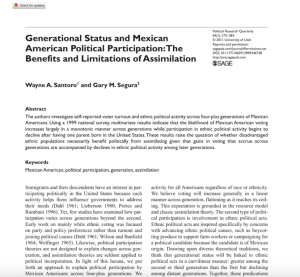
Carlos’ paper is not the only one that my research contributes to. The paper “Generational Status and Mexican American Political Participation: The Benefits and Limitations of Assimilation” by Wayne A. Santoro and Gary M. Segura. Santoro and Segura look at the increase in voter turnout throughout generations as well as ethnic voting activity. They both see a similar trend in the increase of political knowledge and turnout, with a decrease in ethnic political activity. While they look at participation as a binary variable, I look at participation using a seven-point party identification scale.

Up to this point, I have not found research that looks at Hispanic voters and assimilation using an ideological scale. My greater hope is that this work can spark a greater conversation about the way that political scientists and practitioners look at Hispanic voters. First, I have evidence to show that the traditional Michigan model of political socialization is not applicable to the second-generation of Hispanic voters. Instead, they are much more reliant on their environment and that causes them to have differing ideology from their parents. Second, the Hispanic demographic is not a binary indicator. It is really a culmination of different voters that are heavily reliant on their environment growing up.
Moving forward, I am excited to present this research and hopefully even publish it in a journal. I feel very confident that this is important work that has value in the political science field. To my benefit, I had the IDEA Grants program to help me conduct this research over time and do so in a controlled environment. If I was doing this work by myself and with no support, I would not have been able to completely develop my ideas. Instead, I had a great mentor, awesome program directors, and deadlines to help keep me on track.
 HSF House Blogs