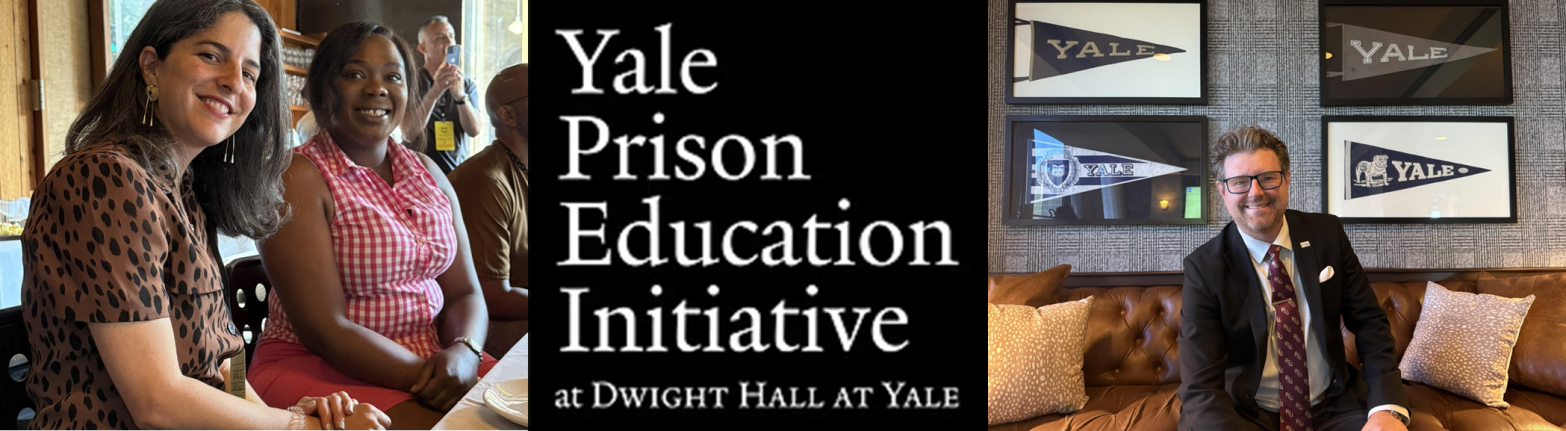
As part of my IDEA Grant research project, I have been reimagining higher education for incarcerated and justice-impacted students. Across the country, more colleges and universities are beginning to recognize the transformative role they can play in reentry and reintegration. Beyond just offering non-credit courses or a certificate of completion, some programs are now providing a pathway to full degree attainment. On July 21st, I boarded a flight to New Haven, Connecticut, to visit the Yale Prison Education Initiative (YPEI) and to see what’s possible when higher education is unlocked for people who’ve been justice-impacted.

Dr. Zelda Roland founded YPEI as a Yale PhD student in 2016 and heads the initiative out of Yale’s Dwight Hall. After two full years of organizing, recruiting supporters, training staff, developing coursework, and obtaining agreements to align correctional goals with academic standards, the first incarcerated students to earn Yale college credit proved it could be done. If there was any question whether the investment was worth it, a national survey by the RAND Corporation found that people who receive a college education while incarcerated are 43% less likely to return to prison. Since launching credit-bearing courses in 2018, YPEI has reached about 130 incarcerated students.
Dr. Roland shared her philosophy on Yale’s role and the initiative’s impact. “One of the reasons why I believe it is so important to do this at Yale,” she said, “is because we know that when Yale does something, other institutions follow.” She gets calls each week from other colleges and universities asking how they might replicate this work. Other powerful models exist, too. UC Berkeley Underground Scholars (BUS), for example, founded in 2013, offers a year-long Policy Fellowship and training institute in addition to pathways into higher education for incarcerated, formerly incarcerated, and justice-impacted students. Underground Scholars with lived experience provide lived expertise in reshaping state-level policy and campus culture. Berkeley’s website describes it as the “prison-to-university pipeline,” and they’re not just imagining it, they’re building it through intentional recruitment, student retention, and passionate advocacy.
Similarly, The New Jersey Scholarship and Transformative Education in Prisons (NJ-STEP), led by Rutgers University-Newark and founded in 2012, is connecting colleges across New Jersey with correctional facilities to create seamless degree pathways for incarcerated learners. What impresses me most is how the program doesn’t end at release–it continues, offering wraparound support and clear transitions into bachelor’s and even master’s degrees. Paul Boyd, a justice-impacted student, is the first from Rutgers-Camden to be named a Truman Scholar. That’s the goal, from margin to model, to use education to shape a justice system that’s more humane, more effective, and more hopeful. Looking forward, that’s the kind of full-circle impact I want to see and help create in Florida.
These models offer more than inspiration; they remind me that the work we’re doing at FSU can matter in real and lasting ways. During our conversation, Dr. Roland shared something that struck me: Yale recently became the first university to establish a full college-in-prison program inside a federal women’s facility. By Dr. Roland’s estimate, no such program had existed in any federal women’s prison. In a space where educational access has long lagged behind, and where gender has too often dictated opportunity—this step breaks meaningful barriers. For the women inside, it means a chance to earn real college credit while incarcerated, and once released, to continue their degrees at Yale or the University of New Haven. That kind of continuity, that belief in someone’s future beyond confinement, is exactly the kind of impact I hope to bring to Florida.
One such person already making an impact is Shelby Henderson-Griffiths, my guide and a College-to-Career Fellow with YPEI. The two-year fellowship comes with a $60,000 annual stipend and a full-time position on campus. It is a paid pathway to fair opportunity that Dr. Roland is particularly proud. During our conversation outside Dwight Hall, Shelby and I discovered that we both started out at Miami Dade College, though she began her path there a few years before me. Now she’s a JD candidate and Policy Administrator at the Tow Youth Justice Institute, helping shape juvenile justice policy across Connecticut. Her story didn’t feel like some far-off example. It felt close, like something I could build toward, too, and something I want to help others see as possible.
I learned from Shelby that in the YPEI program a person’s sentence length is not a barrier, like it is in Florida where those serving a life sentence are removed from eligibility to take part in a 150-hour foundational educational component (section 944.801, Florida Statutes, 2023). Since these basic education hours are often a prerequisite for advanced or college-level programs, it creates at the first rung a barrier for “lifers” to access any broader educational opportunities within the system. Beyond these bars, Yale also raises private funds to support students who are ineligible for Pell Grants. As Dr. Roland put it, the goal is to make sure that “students have no bars to their education.” She also noted that Connecticut considers incarcerated students to be in-state for tuition purposes, a policy that helps remove yet another layer of structural exclusion.
While the Yale Prison Education Initiative is a full college program that runs inside prison facilities, with class sizes capped at 12 students, their program is expanding and last year alone they received over a hundred applications. There is interest among the incarcerated for higher education. Yale is showing how education is moving people out of the margins and toward a national model, and it reminds me that the work we do at FSU can be the leader in Florida as part of a national movement.
Standing in the greatness of Dwight Hall, I reflected on my encounter with Dr. Roland and Shelby, and how they helped sharpen my own approach. It reminded me that interviews aren’t just about collecting stories, they’re about honoring them. That’s one of the reasons I made the trip in the first place: to learn how justice-impacted students are being supported in Connecticut, and to bring those insights back to Florida. My IRB is still pending, but I’ve been using this time to get ready, sharpening my questions, thinking through the kind of space I want to create, and learning from others who’ve been doing this work well. As soon as approval comes through, I’ll begin interviewing students at Florida State University whose perspectives will help shape not just the research, but hopefully the institution itself.
Closer to home, I’ve connected with like-minded students and we’re already laying the groundwork for launching the Justice-Impacted Student Organization (JISO). Our logo has been approved, and we’re currently applying for full recognition as an official Registered Student Organization (RSO) at FSU. Even in this early stage, I’ve had students reach out to say things like, “I’m glad there will be a place for someone like me.” That quiet affirmation, at times hopeful, and at times expectant, is exactly why this work matters. It tells me we’re meeting a need, even before the doors officially open.
If you or someone you know would like to learn more about how “Degrees of Opportunity” and JISO have the potential to create scholars and leaders at FSU, then please come hear me speak at the FSU Leadership Speaker Series on September 30th in the Dunlap Success Center. I promise, once you have heard the research and the vision behind JISO, you will see a future where justice-impacted students aren’t just welcomed, they’re embraced as essential members of the FSU community. Then in October, I’ll be presenting at the President’s Showcase of Undergraduate Research Excellence, which celebrates the work of IDEA Grant recipients across disciplines. It’s exciting to know that this project, rooted in lived experience, will stand alongside some of the most rigorous academic work at our university. I am honored to know that JISO is one part of that work, and its mission is simple: to make sure no one’s voice stays marginalized.
 HSF House Blogs