By Reagan Gibson, Florida State University
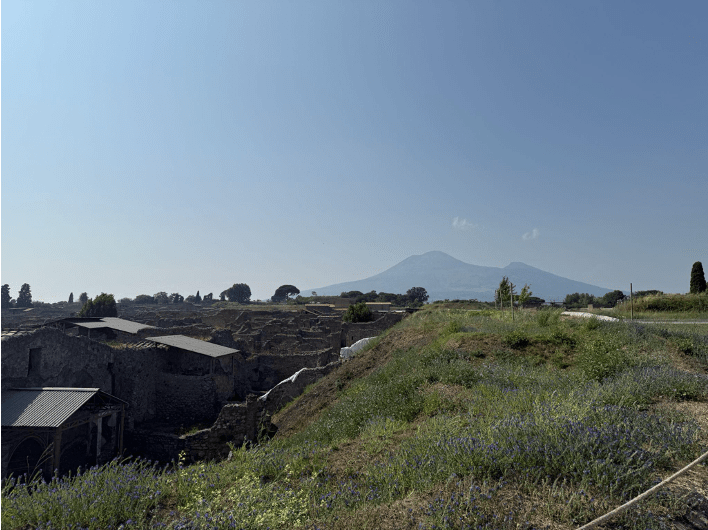
As time continues to pass in the beautiful Tuscan countryside, I find myself in a constantly evolving situation where I move back and forth from my professional life and my academic career. In the past month, I have only been working at the archaeological site of Monereggi in Montelupo-Capraia, but now I have moved to Florence to study in Florida State University’s study abroad program. This poses new challenges for me and for my research – mainly affecting me in the form of time management. While on site, it was easy for me to take the weekends off to work and write. Now, however; I am back at school for another semester, which seems to have the uncanny ability to overtake my life with almost immediate effect. I am only taking two classes, but the courseload and the addition of more work to my load is already challenging (during week one). It seems that these next six weeks may be more difficult than I had originally anticipated. As the work load increases, it will definitely be difficult to balance all of the data collection, analysis, and writing.

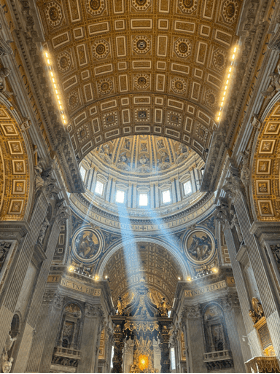
Even though the process has been overall tiring from the myriad of travel and social activity, I do find myself feeling more passionate and inspired about my topic than ever. In the past few weeks, I have visited Rome, Naples, Florence, Siena, and Pisa, which has shown me not only some of the most beautiful sites in the world, but also the active effect of the spread of neoclassism across Italy (even in the small and remote towns). As shown, there is obviously a direct link between the exposure of frescos in the 18th century in ancient Vesuvian cities such as Pompeii, and stylistic shift in both the domestic and legislative decorations. This correlation is well known, and even where the modern term “neoclassicism” comes from, but seeing it in person while investigating my own research project and witnessing the timeline of events is incredibly inspiring. There is nothing like encountering such beauty and architectural prowess in a modern world full of strictly functional and brutalistic design features. It is truly stunning to witness, and incredibly moving – in a way that pictures cannot hope to express. The features of a camera are only so adept at capturing an image, but one cannot see the light as it glows in the stained glass of the windows, nor the smell of burning incense and wax at the altars. It is easy to see how people have spent centuries building these vessels of a holy entity – especially when one feels the very veil between the earth and the aether begin to blur.

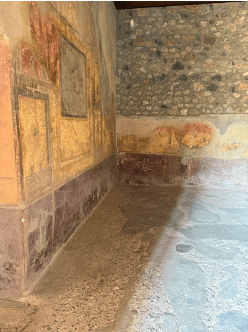
This is also true, I think, in the temples of the old gods. In Pompeii, where there is so much present and yet so much missing, the designs of the frescos and the walls reach out to enthralled viewers, and coax them into enchanting conversations – some of which are likely the same topics that were discussed in antiquity by the owners of the villas. These are the things which convince me that I am doing something that matters. This feeling is impossible to replicate, and is why this research is incredibly important and necessary to communicate the past to the present in a coherent and accessible manner. So, despite the trials of my time in Italy thus far, I cannot imagine a way that I could be more successful at this point.

 HSF House Blogs