Children’s National Research Institute
By Lauren Afong
This summer, I have spent a lot of time thinking about what it means to “collect data.” On the surface, the phrase sounds sterile—pulling numbers from spreadsheets or coding survey responses. But through my time at Children’s National Reserarch Institute, I am realizing how nuanced the data collection process can be, especially when it involves real people and real communities.
Our project looks at how the Affordable Care Act has impacted pediatric primary care provider utilization across Washington D.C., especially in areas with low child opportunity. At first glance, the project seems data-heavy: from working with census-tract level data to health insurance legislation to neighborhood-based checkup rates. But over time, it has become clear that numbers do not speak for themselves—they require context and relationships to mean something.
I have had the privilege of talking to several experts during this project, but one conversation that stood out in particular was with Dr. Chaya Merrill, one of the directors within the Child Health Advocacy Institute. When I consulted her regarding the lack of pediatric data that exists in relation to the project, she reminded me that research is not solely about finding answers but rather making sense of what we do have. Often times it means finding comfort in complexity. This was once again highlighted by Dr. Clemens Noelke, who helped me find my footing within the context of our disconnected frameworks. He noted that there could not be one metric to serve as the intersection between child opportunity and primary care provider utilization because of how multifaceted it is. His words, as well as Dr. Merrill’s, allowed me to work outside the box and move forward with the creation of a new index. In doing so, I can proudly say that I have helped to bridge a prominent gap in research.
Being in these spaces has allowed me to reflect on my role as a student researcher. Even though I am not from Washington, D.C., I deeply resonate with the topic at hand and the individuals behind the numbers. Still, I have learned to pause and ask: How am I influencing the story I am trying to tell? Just by asking questions, I am helping to shape the narrative. Such a large responsibility has made me approach everything with more humility.
I find myself co-constructing knowledge every day, recognizing that meaningful understanding is built with communities, not about them. It is a collaborative process that values lived experience just as much as data. In this approach, research is not extracting information for academic gain, but more so creating space for dialogue to frame the direction of the work. Through my research, this has become even more evident. Collaboration transforms data into something more than numbers; it becomes a tool for equity, built alongside the very people it is meant to serve.
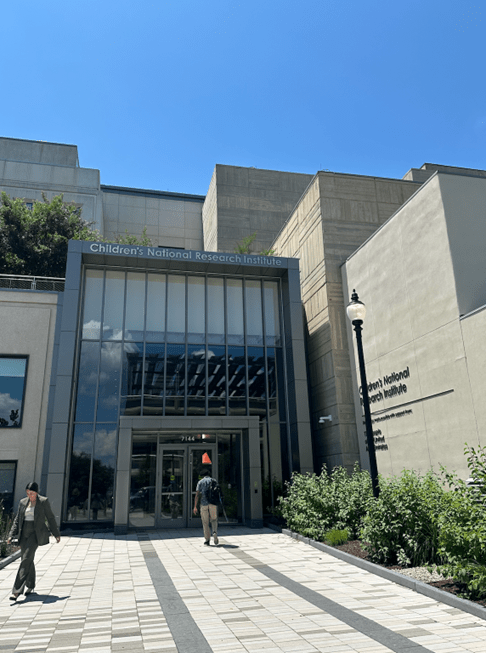
Children’s National Research Institute
 HSF House Blogs