Hello again! My name is Kellan Kissinger and I am an IDEA Grant recipient currently working on an Honors in the Major thesis about how female utopianism appears in medieval and contemporary texts. Specifically, my thesis aims to explore the intersections between Christine de Pizan’s medieval A Book of the City of Ladies and contemporary feminist literature, particularly focusing on themes of female utopianism, dystopianism, and gender roles. De Pizan’s work, written in the early 14th century, constructs an allegorical city where notable historical and mythological women build a symbolic refuge, ultimately challenging the prevalent misogyny and inequality of de Pizan’s time that I believe has echoed into our future. While de Pizan’s work will serve as the foundational text for this project, two other texts will also be considered to trace the evolution of female utopianism and dystopianism through history: Mary Wollstonecraft’s A Vindication of the Rights of Woman and Sherri S. Tepper’s dystopian novel The Gate to Women’s Country.

One of the biggest hurdles for my project so far has been examining how three very different authors, all writing in drastically different time periods, imagine female utopianism, critique patriarchal systems, and reimagine the roles women might play in a better society. Analyzing these works in conversation with one another requires a flexible approach to textual analysis that I have not been exposed to very much. There’s a lot of re-reading and referencing outside sources to make sure I’m understanding the texts. I also partake in a lot of note-taking, highlighting, and annotating to make sure I understood the authorial message, societal implications, and overarching similarities and differences in all of these texts as I read. On top of that, I’m trying to make sure my analysis doesn’t flatten the uniqueness of each of these texts for the sake of comparison.
To manage this hurdle, I’ve been returning to my research questions to make sure that I’m staying within the breadth of the project I decided on at the beginning. I also have been reminding myself that although these texts are very different, I chose them because I saw something that was unique to all of them and I need to keep chasing it even if in the thick of it I might lose focus a little. Interestingly, one thing that has surprised me so far is how relevant de Pizan’s A Book of the City of Ladies still feels. Despite being written over 600 years ago, de Pizan’s critiques and message still resonate with the issues women are having and responding to in today’s society.
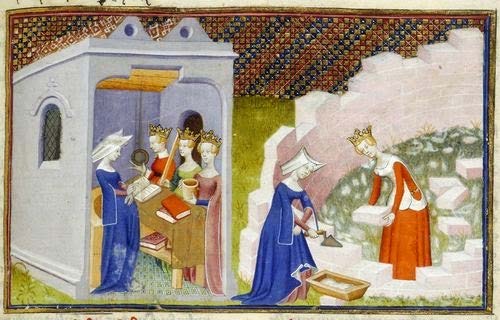
Despite these challenges, this project continues to inspire me when it comes to analyzing female values and hopes in society. For example, one of the best parts of this project is seeing how de Pizan and Tepper’s texts contrast beautifully. While de Pizan dreams of a separate space for women that is protected from male slander, Tepper questions this utopian vision through a dystopian lens. What is the possible cost of feminist spaces? Should there be a binary between the male and female in society in any capacity? Tepper’s work asks these questions and subverts the typical look at female utopianism. Small little discoveries like this have been such a rewarding part of this project. I’m seeing how my original ideas are coming to fruition. It reminds me of why I fell in love with literature in the first place: it allows us to engage in dialogue not only amongst ourselves but with writers across time, languages, and ideologies. Hopefully, through that dialogue this project will reveal both trends in the past and our present moment in female utopianism. Can’t wait to share more!
 HSF House Blogs