Greetings Esteemed Reader,
This past month, completing a big band arrangement of ‘Smart Race’ and finishing the theme of ‘Celebration’, the last movement of my big band suite, revealed some persistent problems I’ll be facing in my tuning methodology. The Lumatone is anticipated to give me insight on said methods, however, it is stuck in customs being reviewed for USMCA compliant tariff nullification. On the technical side, I’ve hit a roadblock in development of the xenharmonic MIDI tuner due to using VLC media player; it has served its purpose streamlining testing, but it’s time to move on to the far more robust Ableton Live 12.

The biggest surprise is that each xenharmonic interval choice can be dependent on interval tunings made before and after in the music. Taking upcoming context into account will be a challenge for the MIDI Tuner because it reads the MIDI as one line of binary. To remedy this, the MIDI Tuner will make multiple attempts each dependent on the last. This is called an iterative method. Steven Strogatz’s ‘Nonlinear Dynamics and Chaos’ will inform my design of this tuning iteration.
Managing surrounding contexts is necessary for keeping melody harmony balances consistent throughout the piece and managing pitch drift. Pitch drift is when the tonic, also known as the root pitch or “do” (do re mi fa sol) in solfege, changes from its initial frequency. This is as if the key of the song is slowly rising or falling over the course of the piece. I need to weigh between compromises, (implement user control to) accept a tolerance of pitch drift , or review with different tools so I don’t need to forfeit some sonorous chord changes. The more distance that autotune has to do, the more distortion occurs, so producers would be forced to write in drifting key changes for performers. I do believe there is a lot of creative merit to explore here. This phenomena is shown clearly through Bennedetti’s puzzles, pieces that are composed to maximize the effects of pitch drift. You can listen to them here. https://www.youtube.com/watch?v=FT71tggrrQc .
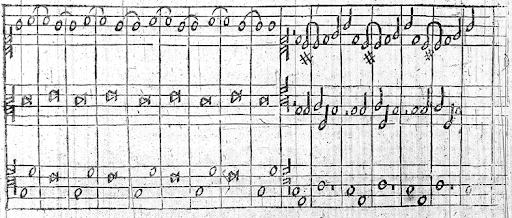
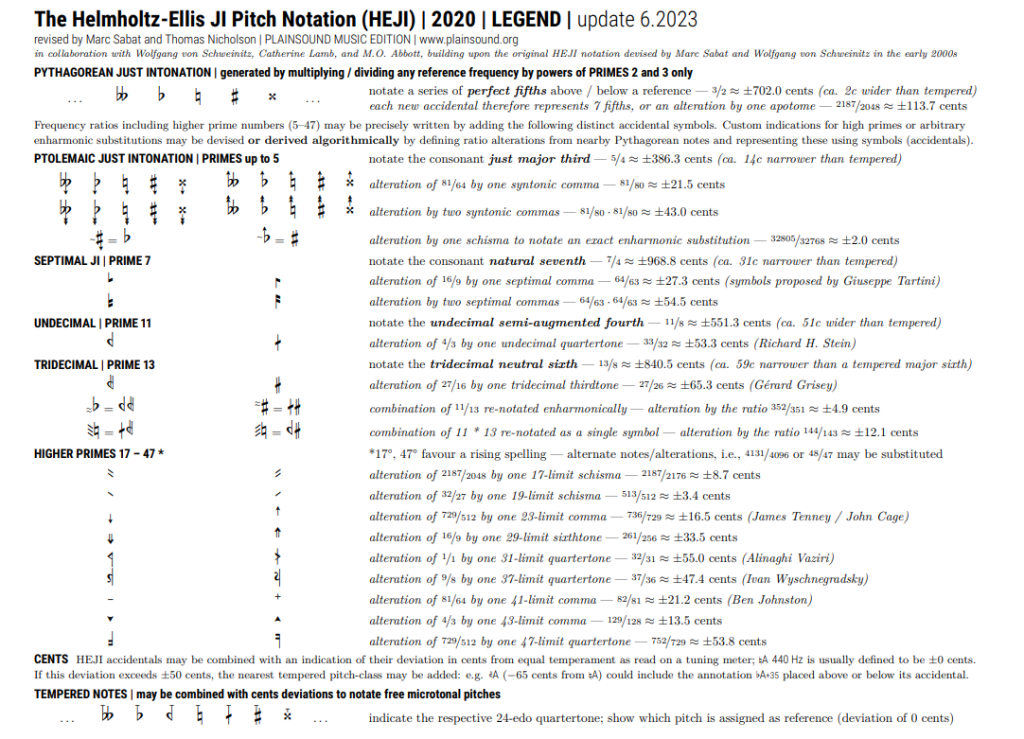
The xenharmonic MIDI tuner can successfully parse MIDI files, identify the components, output a tensor for future analysis purposes, and return a playable MIDI file. However, there is a little debugging left on making sure the pitch bending applied is in sync with the MIDI player. Ableton live 12 will provide a deeper look into this issue. The program is currently using a basic tuning schema in place of what I’m working to discover. Music theory and composing has often required a piano to test, express, and explore music primarily as sound, and secondarily as an organized layout. The Lumatone’s unfamiliar yet necessary xenharmonic intervals are necessary to guide my programming. It is waiting in Toronto for tariff nullification at customs. To circumvent further waiting, I will have a family friend personally retrieve it. To prepare myself for a mental framework beyond 12-tone, I will start using a xenharmonic musescore plugin with the following notation.
The goal is to have a thorough methodology and understanding of harmonic transitions in the vector space model. My biggest hurdle will be interpreting and applying the nonlinear potential of this process to the tuning algorithm. That being, a particular tuning in a particular part of the song is dependent on the context before, and after it. I need to do drills on pencil and paper to build the quick recognition needed to see higher level patterns, as well as review ‘Numerical Linear Algebra’ from the class my mentor, Dr. Hubicki taught me.
 HSF House Blogs