For my topic comparing Italian and American work-life balance, I’ve been speaking with fellow interns who are working in similar sectors to mine as well as others like clinical, business, and hospitality. I approached them by explaining my capstone topic and asking if they’d be open to being interviewed. These conversations gave me a clearer understanding of how work and life blend in Italy, and I found myself relating to many of the points that came up. One comment that stuck with me was from a friend who said she was surprised by how personal workplace relationships are in Italy compared to the U.S. That made me reflect on why that might be and think back on my own work experiences.
In terms of my observations, I’ve been taking notes on what stands out to me the most about Italian culture and how it compares to the American approach to work-life balance. One of the biggest differences I’ve noticed is how relaxed the environment can be when it comes to scheduling and completing tasks. When I started my internship, there wasn’t a set schedule for when to arrive or leave, and there were no firm deadlines for tasks. At first, this lack of structure felt confusing. I later learned that in high-context cultures like Italy’s, communication often relies on unspoken understanding. Since I wasn’t familiar with these cues, I ran into a few communication challenges.
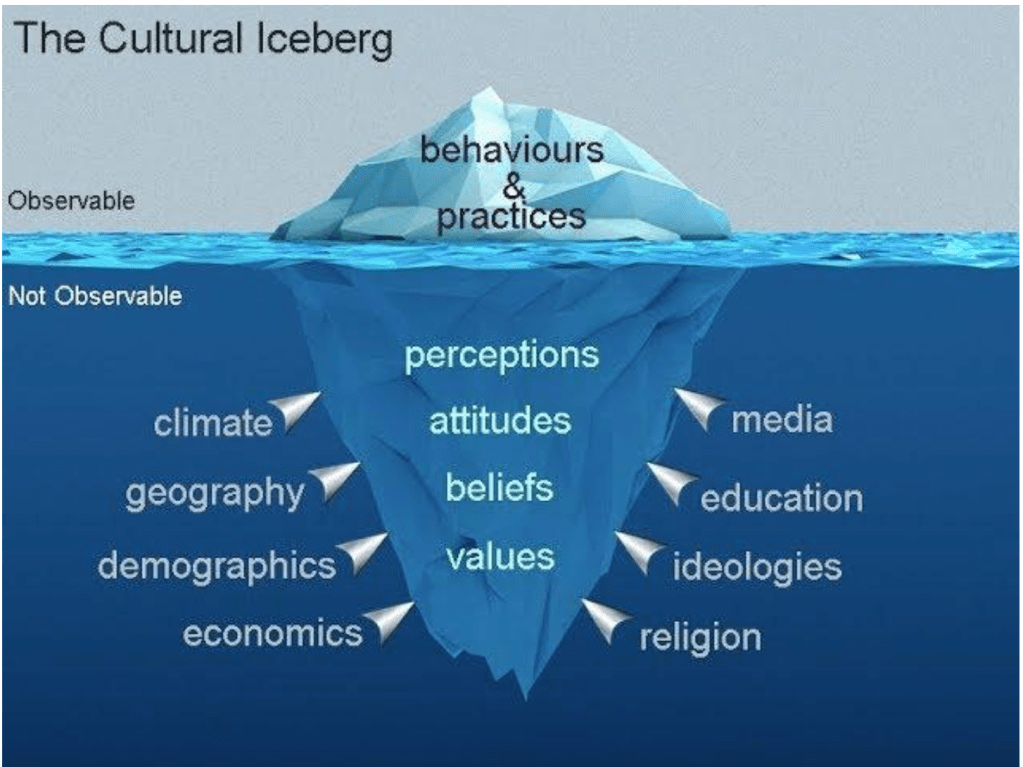
Edward T.Hall Iceberg Model of Culture
This experience has really sparked my interest in understanding my own cultural communication style and learning how to interpret those of others. It also reminded me of a story my instructor shared. She once worked with a French colleague and would recap the main points at the end of each meeting to ensure clarity. Her colleague found this redundant and even slightly offensive because, in his culture, that kind of repetition is often used with children. She explained that this experience, among others, taught her how different cultures interpret communication and how these differences can impact the workplace. After their conversation, she adjusted her approach and stopped including long recaps.
At work, I’ve also noticed that our Italian colleagues are learning about American culture through us. It’s been fun to see the differences and similarities and to share that exchange. The interviews have also given me the chance to ask the questions I’ve been holding onto, and having those conversations has been both insightful and enjoyable.
To me, co-constructing knowledge means building understanding through conversation and collaboration. This has been essential in exploring my community-based issue, since it focuses on how interpersonal relationships shape both work and personal life. These interactions have helped me gain perspective and better understand experiences beyond my own.
 HSF House Blogs
Hi Alanna, I thought your observations about how Italian work relationships are more personal than in the US was very interesting. Your exploration to how interpersonal relationships impact work-life balance is something everyone can relate to and I found myself drawing comparisons from my own life to your cultural studies!
LikeLike