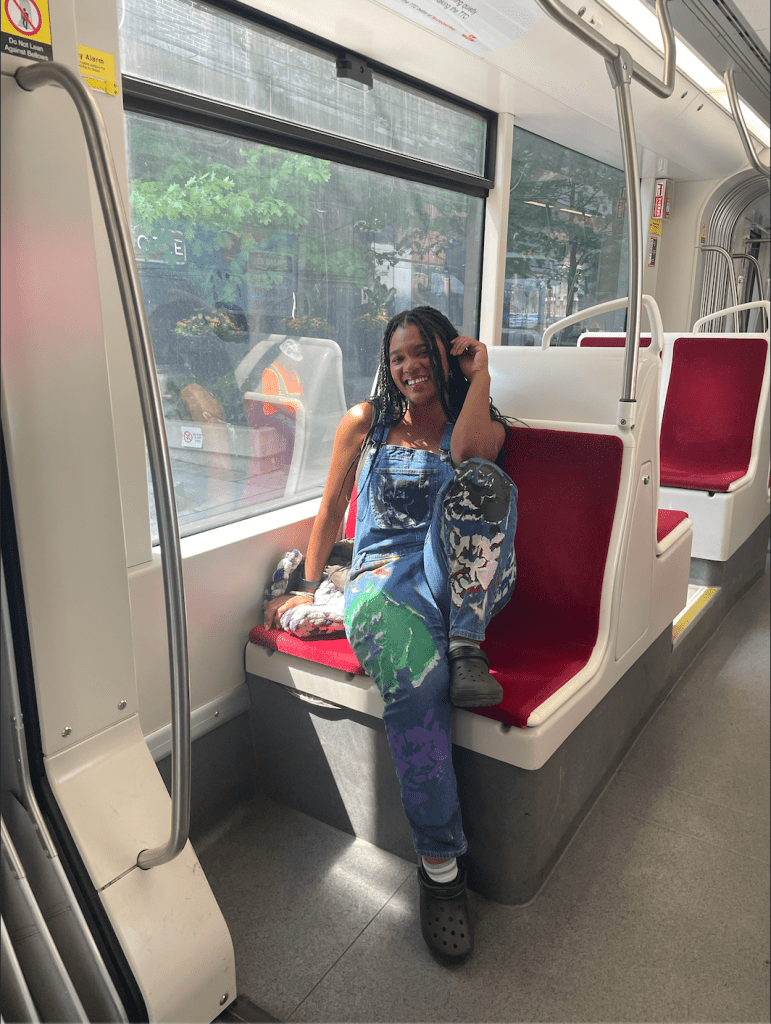
By Angel-Amon Wildgoose
Six times! Six times at Locust Grove High School, I had to serve detention for the one thing I still struggle with to this day: talking too much. Teachers would move my seat, isolate me from my friends, or put me at the “Silent Table” to eat my sandwich while my teacher scowled at me like a prison guard. All of this, and you could still never shut me up. College has been the one place where being a yapper has had its perks. For example, not too long ago, I walked into Scarborough Mall to grab a few things from Walmart (Yes! Some Canadian malls have Walmarts inside them!), but I stopped to look at some blankets at a home goods store.
Mary (which is what we will call her), the district manager, asked if I wanted to see ALL of them spread out so I could make a better decision. Somehow, this started as a conversation about blankets and linens, then Toronto restaurants, then the details of my research. At this point, we’re 2 hours into uninterrupted lore about our lives. Mary is a first-generation Canadian whose family comes from the Philippines (near the same city my host family is from). Though she grew up in Scarborough, in 2008 she moved with her family to a town just north of Atlanta called Marietta, about 45 minutes from where I grew up. When they came back to Toronto, her son used a lot of his influences in Atlanta to make a name for himself in the hip-hop music industry. In true blabber mouth fashion, I asked her tons of questions she was comfortable answering except this one “What is your son’s name?”. She hesitated, and told me she doesn’t tell a lot of people (so y’all have to keep this secret too! This is why I gave her an alias!) but her son is the rapper KILLY. KILLY is a certified platinum recording artist who just got off a world tour with a popular American artist named NAV. Of course my jaw dropped because he is a fraction of my research on new-aged Canadian rappers.
Mary and I talked for about another 30 minutes, but one thing she said about Canadian rappers sat with me for a moment. When I asked her why Canadian hip-hop artists struggle to gain success globally, she says “Well, when they’re trying so hard to mimic what they see American artists in New York, Atlanta, or LA do, it comes off as phony, ya know? Apples and oranges type of thing. I told my son that authenticity and honesty is key… plus, if I ever heard him on a track lying about how he was raised… saying he ‘went without’ anything… that track would never see the light of day.” I understood. With Canada being stereotyped as this “safe haven” where “nothing bad ever happens” there is a bit of truth to it. Yes, crime, poverty, and gang violence are very real here, but it does not compare to the major scale of this we see in the United States, even specifically in Tallahassee.
What Mary and I spoke about came back around full circle during my observational experience. I was honored to follow Dr. D’Amico at the Hart House at UofT to see what a day in her life at the Hip Hop Education Center looks like. While there, she set up interviews for me with nationally known hip-hop artists and they will be conducted via Zoom when I return to Florida. I received the grand tour of this castle that was commissioned by the Massey Family in 1919, and named after Vincent Massey’s grandfather, Hart Massey. I was also granted a look around the longest-running college hip-hop radio station. Some points that stood out to me are that there is a very small population of hip-hop scholars in Toronto, Hip-Hop is very underrepresented here, and many of those who promote it do not have a lot of respect for the people who make it. Dr. D’Amico told me it is very important to include that last point because of what we encountered with a staff member during my tour. Though he was making a point about hip-hop not being accepted initially at the radio station, he very loosely used the N-word to describe what type of music the director at the time said he would never play at the station. This does not discredit the Hart House for what they do and their amazing influence on hip-hop culture in Canada, but it proves the point that someone can promote the music without having much respect for the race of the artist. Shout out to Dr. D’Amico for speaking up about it and telling their dean about what was said.
Personally, I think, especially in that situation, that my influence on my environment is just as important as the environment’s influence on me. This brings me to the idea of “co-constructing knowledge” which means (to me) building a repertoire of understanding or consciousness through tales told from several different walks of life. My personal interactions, stories, and background, accompanied by those same characteristics found in the people I talk to here can build a new perception of the world around us. Considering what trauma and hardships I carry as a young black woman from a small city in the south, my reaction to the staff member’s comment hopefully taught him never to use such colorful language in a setting like that. In relation to my community-based issue, this instance proves valuable on the disparity between Black Canadians and how they are accepted, and how hip-hop’s popularity is growing despite a lack of respect for the artists.
I’m grateful for these blogs to be able to publish my honest opinions and professional and personal accounts of traveling to another country. I’m also grateful for my ability to speak up, always. This did not change how I feel about my experience, but it strengthens my argument for my Honors In The Major project.
 HSF House Blogs
This was very insightful! Reading your blogs this summer has been an amazing experience for me through you. I thank you for sharing.
LikeLike