By Sophie Works
Hello everyone, Sophie here! As I am preparing to leave for Riga, Latvia this weekend, I’ll be outlining some goals I’ve set for myself to help guide my growth over my summer experience.
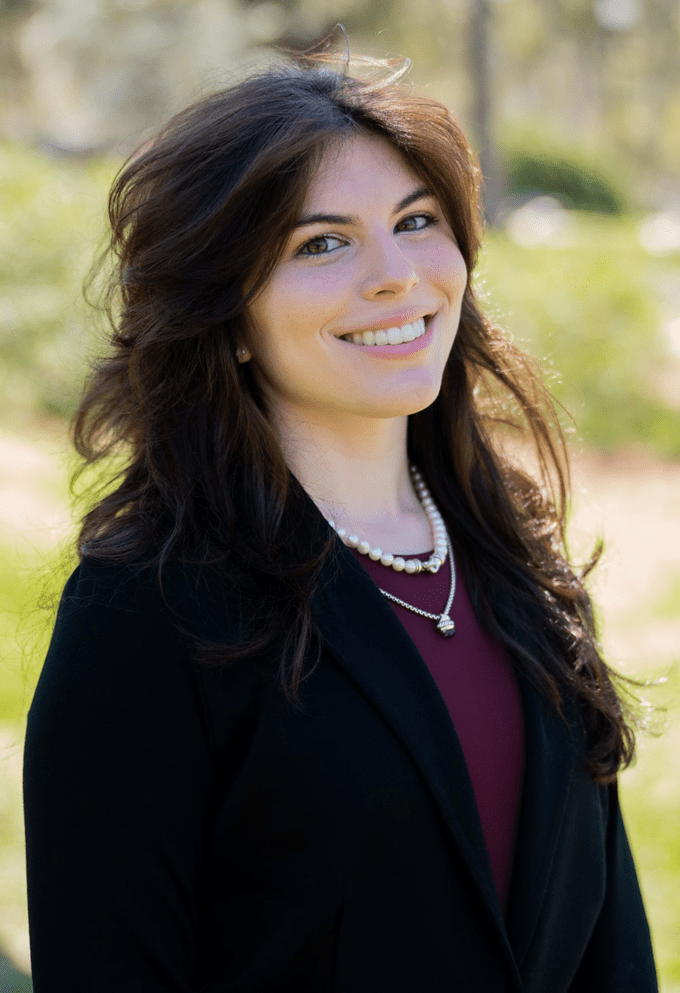
Sophie Works, Russian (Slavic) Studies and International Affairs Major, Tyler Center for Global Studies Undergraduate Research awardee, Edna Ranck International Studies awardee, and Global Scholar
To refresh you guys on what my experience is, I will be traveling to Riga, Latvia for four weeks. There, I will be attending Russian Language Academy BORN where I’ll take intensive Russian courses taught by native speakers.
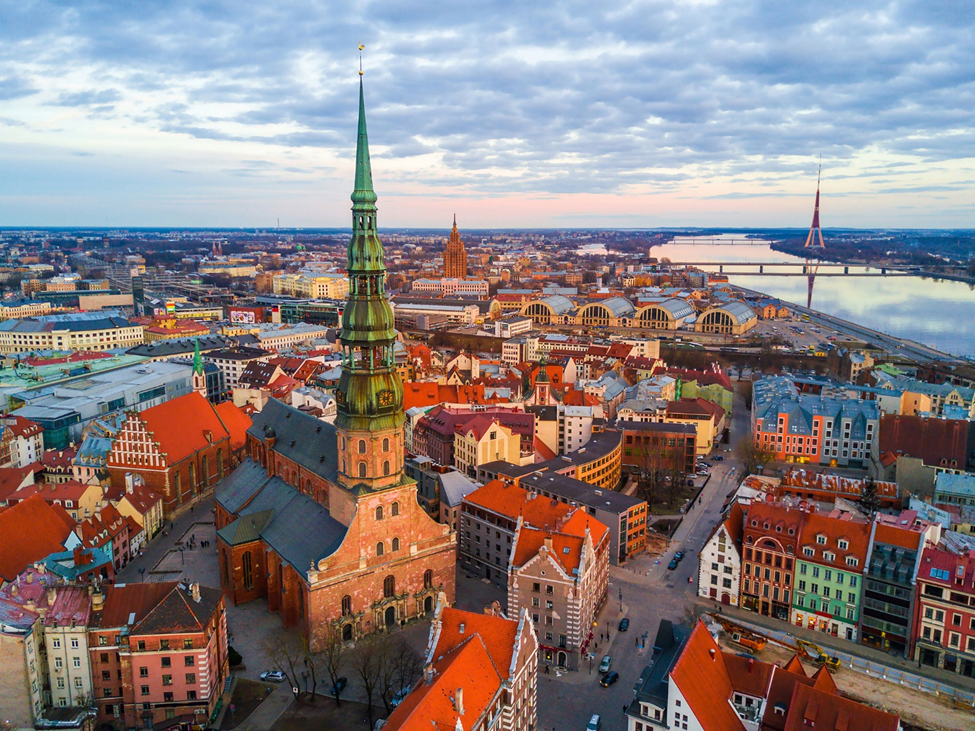
Historical Old Town where Russian Language Academy BORN is, Riga, Latvia
On top of this, I will be conducting my honors in the major research project where I will be interviewing ethnic Russians living in Latvia. In practice, this looks like archival fieldwork as I will be photographing a type of Russian folk craft, Russian lacquer art, in the homes, stores, and workplaces of my interviewee’s. This will eventually translate into a digitally accessible repository of photographs, 3D models of the lacquer art, and stories of my participants to provide a non-commercialized learning platform for these intricate pieces.
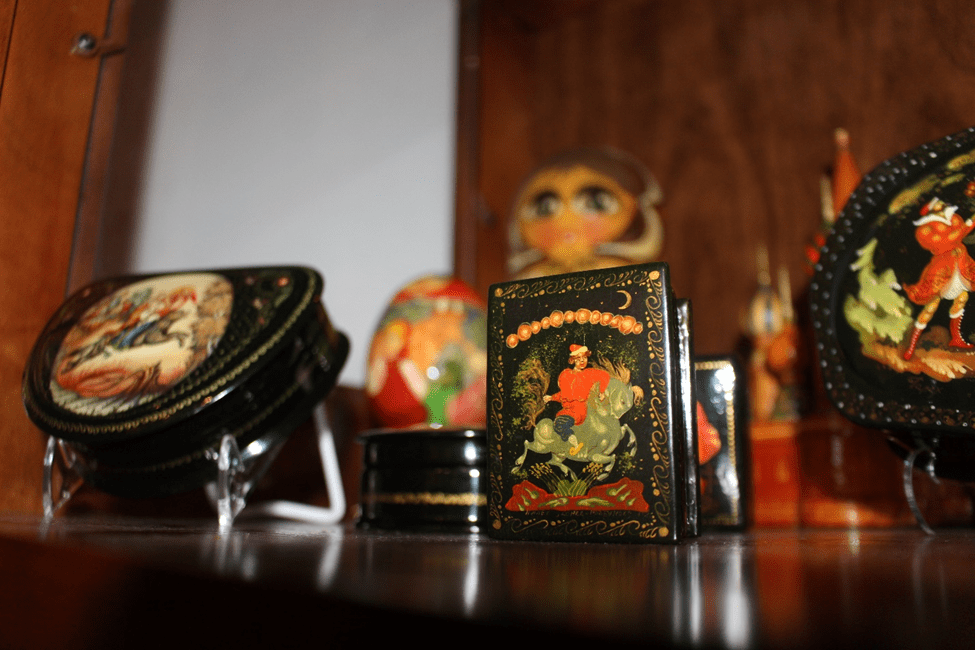
Ivan and the Humpbacked Horse, Palekh, USSR, Lacquer, papier-mâché
With all this in mind, there are three major things I want to do during my stay in Riga: visit the former KGB “corner house” at the Museum of the Occupation, take a painting class at the Riga Porcelain Museum, and attend the Baltica Festival. These three activities are interesting to me on both a personal and academic level.
With the Museum of the Occupation, it is a compelling museum that features exhibits containing Soviet-era objects, testimonies, and art detailing the occupation of Latvia by the Soviets and Nazi Germany.

Museum of the Occupation Exhibits, Riga, Latvia
Personally, I am fascinated by the interwar period between WWI and WWII, the Bolshevik (Communist) revolution of 1917, and the events leading up to the “beginning” of WWII.
Academically, I get to learn about these interesting time periods in courses like “Russian Foreign Policy from 1800-Present” or “War of the Mind: Conflict and Contested Memory.” However, these events are mainly taught through the perspective of the two major players: the United States and Russia. Lectures or units covering the occupation of Latvia and the Baltic states are usually covered and moved on from in just a few PowerPoint slides. So, by visiting the Museum of the Occupation, I will be able to enrich my historical perspective and understanding through seeing these experiences through the Baltic lens.
Moving on to the next museum, the Riga Porcelain Museum is one of my most anticipated visits. If there’s anything I love more than Russian lacquer art (which is almost impossible), it is most definitely porcelain. As an avid antiquer, I am constantly on the lookout for a type of Hungarian porcelain, Herend, and any type of English bone China porcelain. So, personally, this visit will broaden my horizons and hopefully add another type of porcelain to my list of favorites.
Academically, I love learning about art history, the craftsmanship behind specific trades, and how to identify pieces in the wild. There is no better feeling than being able to point out a non-obvious antique you both love and know is valuable—I like to call it the “thrill of the hunt”. Additionally, seeing how various ideologies, economic states, and intelligentsia of a state affects the production, purpose, and look of a craft will always be infinitely intriguing to me. A great example of this is seen in Russian lacquer art—which originally began in the 16th century as religious icon painting with a flat, angular Byzantine-style.
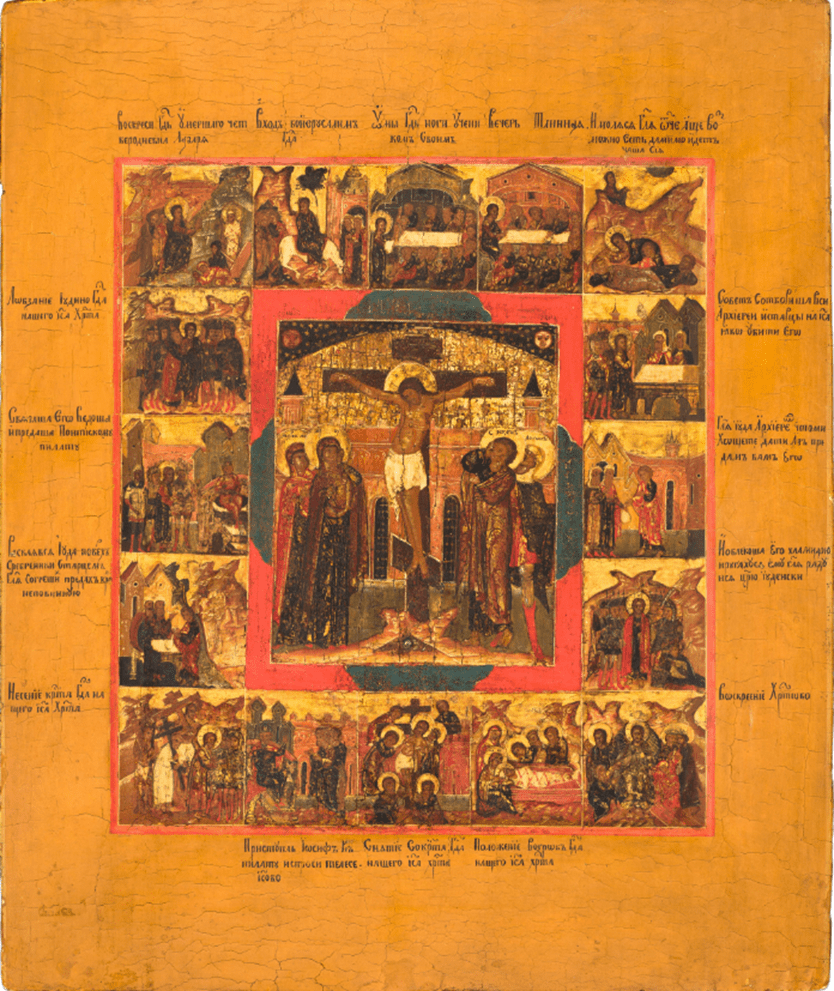
The Crucifixion, with the Passions of Christ and Church Feasts in 16 Border Scenes,17th century, Volga Region, Russia, wood, gesso, tempera
But as time went on, the market’s desire for humanistic, western-inspired art grew. As a result, Imperial Russia’s icon artists gradually made the stylistic shift to reflect this. This preference was condemned by Russia’s then intelligentsia until the Bolshevik Revolution in 1917.
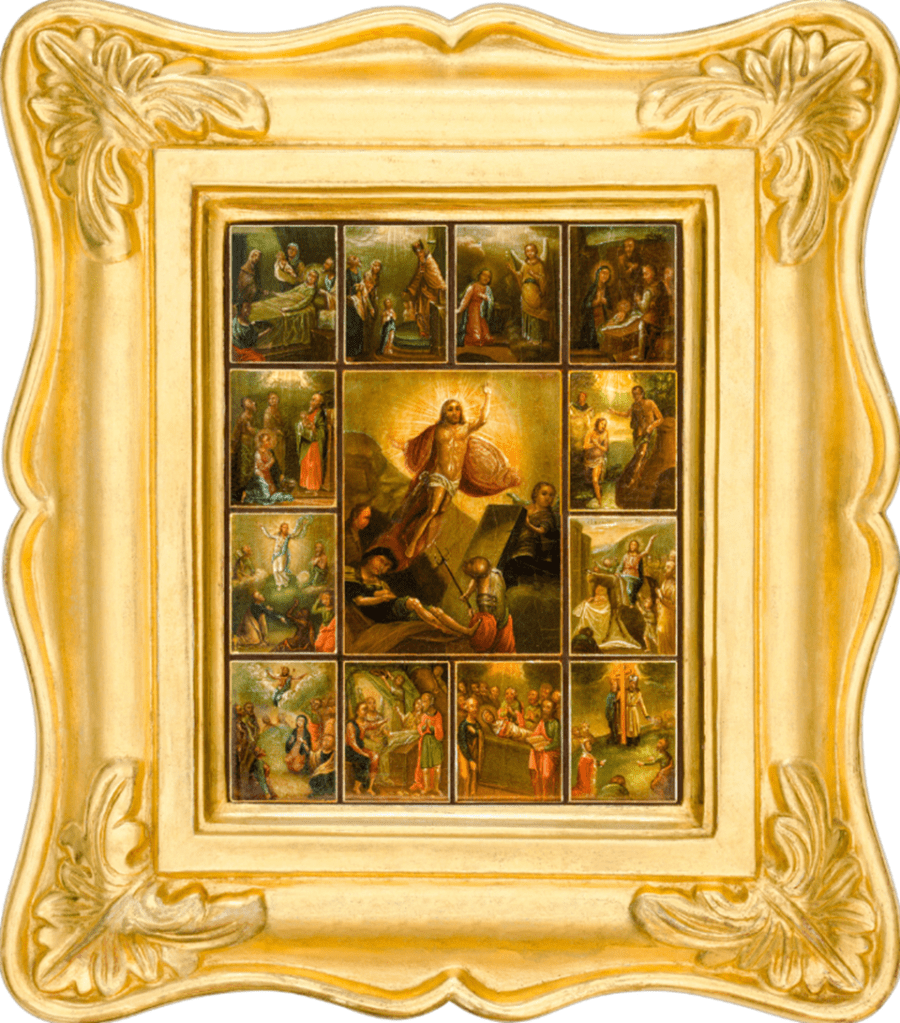
The Resurrection of Christ, with Church Feasts in 12 Border Scenes, end of 19th – early 20th century, Volga Region, Russia, wood, gesso, oil
And since the USSR was an atheist regime, the production of religious iconography stopped entirely. In the decades to come, however, these artists would take up a new form of miniature painting where they depicted classic Russian folktales, motifs, landscapes, and architecture to fill the cultural void left by the morally destructive coup of the Bolsheviks. This now leaves us with a distinctly Russian folk craft, rich with ideological, economic, and cultural history.
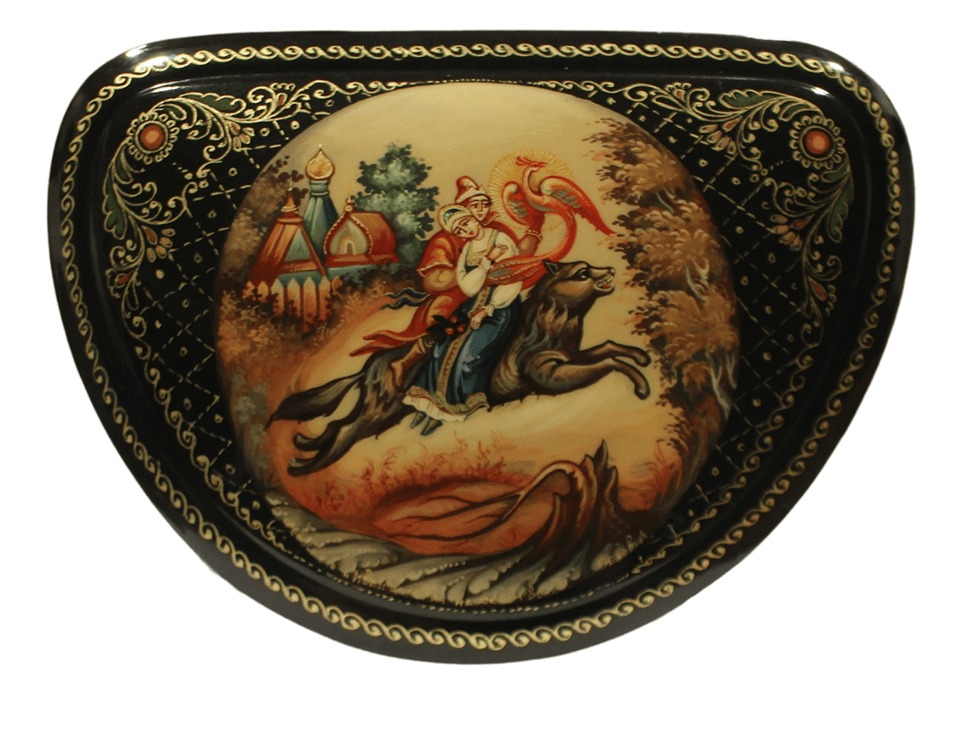
Tsarevich Ivan, the Firebird and the Gray Wolf, Fedoskino, USSR, Lacquer, papier-mâché
A similar transition can be seen with Herend porcelain, English porcelain, and assumingly, Latvian porcelain. Having the opportunity to see this transition through the museum’s phenomenal exhibits as well as participate in the craftsmanship of one through a porcelain painting class is a beyond exceptional opportunity to learn about this incredible phenomenon first-hand.
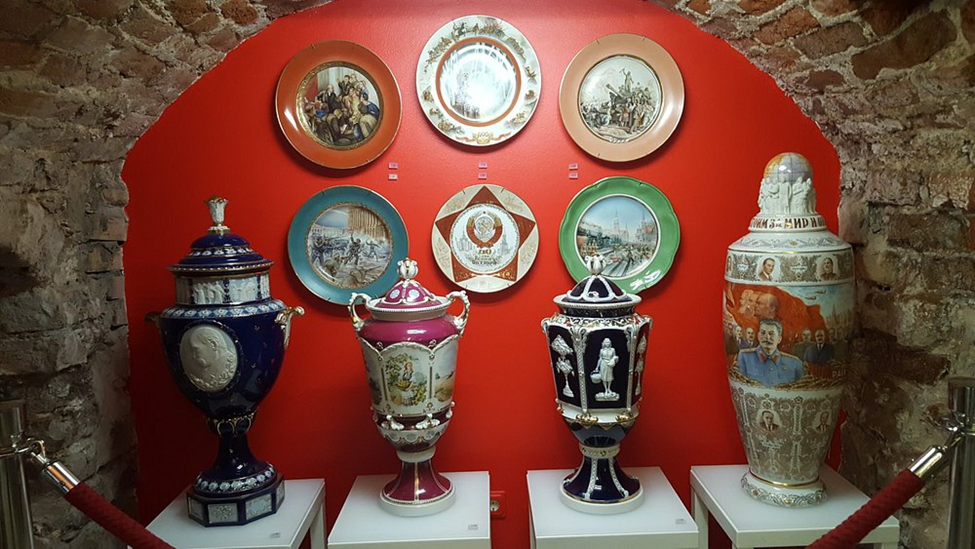
Latvian porcelain depicting Soviet leaders and characters (Joseph Stalin, Vladimir Lenin, Karl Marx, etc.) and events (Bolshevik Revolution[s], proletarian village life, etc.), Riga’s Porcelain Museum, Riga, Latvia
In a completely different setting and style, the Baltica Festival is a folklore festival that moves throughout the country. It starts in the historical old town of Riga and ends in the Russian-majority countryside of Daugavpils. This year, it celebrates the theme of language by inviting participants to explore “patterns, rhythms, sounds and character of your own local area in words, music, song, dance, stories, crafts and the manner of playing music to remember the forgotten and recover the lost, to highlight the peculiar and strengthen the fragile” (International Folklore Festival Baltica).
Starptautiskais folkloras festivāls BALTICA 2018, 16/06/2018, The Freedom Monument, Riga, Latvia
Personally, I am excited about this event because of the opportunity to partake in traditional Latvian customs revolving around food, music, dancing, clothing, and oral history. It’s an incredibly accessible experience taking place on the doorstep of my language school.
Academically, this festival will provide a chance to practice my Russian conversation skills with the many Russian folk performers that will be attending. I will be able to hear and learn specialized vocabulary not usually used and taught in an academic setting. Also, I hope to learn a great deal of Latvian phrases and words to pay homage to Latvia’s unique and separate culture, language, and history.
Throughout these experiences as well as the rest of my trip, I aim to work on two major skills: my outgoingness and technological specialization. An example of these skills being used can be seen in my recruitment process for interviews with ethnic Russians. Because lacquer art is mainly displayed in the home, every recruitment email I send out to possible participants asks if I can enter their home and touch, possibly, their most prized heirlooms and/or possessions…talk about awkward! So, to combat this somewhat uncomfortable question, I curated a mini flyer of myself showing my own lacquer collection, face, name, and shortened title of my study to be attached with each email.
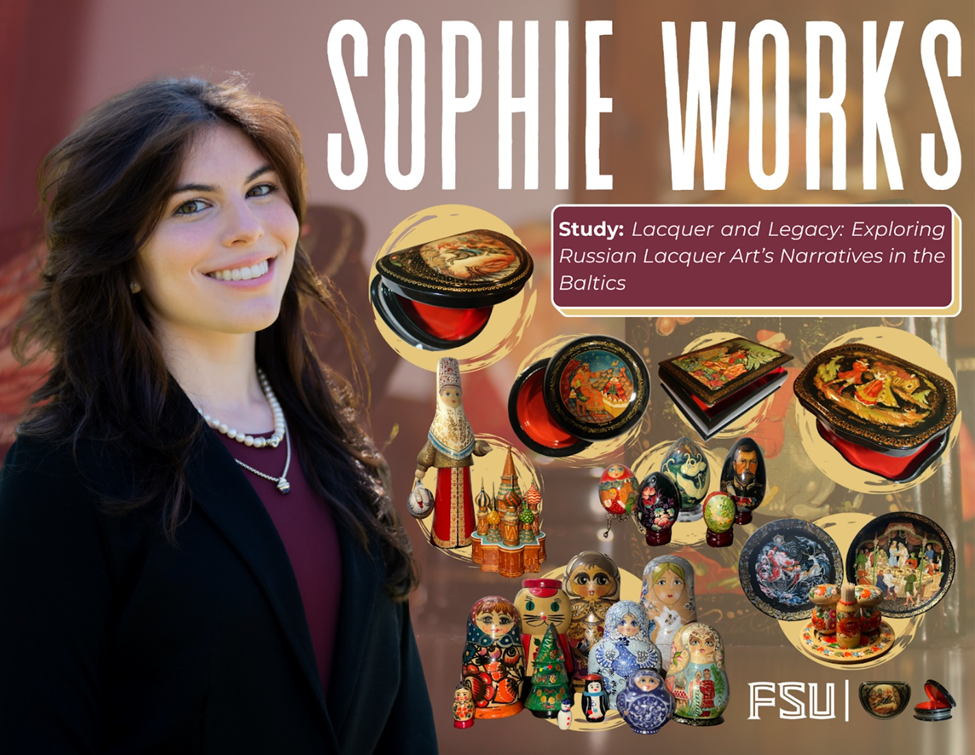
Sophie Works Meet Me, Canva
And while making this did ease my own nerves and cringiness, it has also made me consider being in my participants’ shoes much more. Because I am the researcher, it is easy to say that I would, of course, let a random stranger into my home to see my lacquer collection. But, having to see it from the perspective of, perhaps, an older citizen on the other side of the world with a completely different worldview and reality, has opened my eyes to how I can reframe my interview process and project as a whole to be more approachable. For example, the full title of my research is “Lacquer and Legacy: Opening the Box to Soviet Narratives and Post-Soviet Realities.” However, talking about anything Soviet—or Russian in general—is considered highly political to speak about in public. Further, calling Latvia “Post-Soviet” is likely to be received as extremely offensive, as the state has been independent since 1991 and is undergoing intense de-Russification efforts. So, understanding when to use jargon—like Post-Soviet—versus more colloquially accepted terms—like the Baltics—is imperative to making my participants as comfortable as possible.
And while making this did ease my own nerves and cringiness, it has also made me consider being in my participants’ shoes much more. Because I am the researcher, it is easy to say that I would, of course, let a random stranger into my home to see my lacquer collection. But, having to see it from the perspective of, perhaps, an older citizen on the other side of the world with a completely different worldview and reality, has opened my eyes to how I can reframe my interview process and project as a whole to be more approachable. For example, the full title of my research is “Lacquer and Legacy: Opening the Box to Soviet Narratives and Post-Soviet Realities.” However, talking about anything Soviet—or Russian in general—is considered highly political to speak about in public. Further, calling Latvia “Post-Soviet” is likely to be received as extremely offensive, as the state has been independent since 1991 and is undergoing intense de-Russification efforts. So, understanding when to use jargon—like Post-Soviet—versus more colloquially accepted terms—like the Baltics—is imperative to making my participants as comfortable as possible.


News reports by Latvian media outlets documenting ongoing de-Russification efforts, LSM+, Latvia Public Media, Riga, Latvia
Technologically speaking, I am also having to grow my abilities and use applications I never could have imagined I would be using. Utilizing resources from FSU’s Digital Humanities Library, I received hands-on photogrammetry (3D modeling from photographs) training throughout this past spring semester. With help from the Digital Humanities Librarian, Aaron Rodriguez, the Manager of Scientific Applications at the Research Computing Center, Marcelina Nagales, and Immersive Scholarship Graduate Assistant, Viktor Okuka, I am now equipped with professional-level photogrammetry software, equipment, and the confidence to use it. On top of this, Dr. Thomas Stephan Juzek of FSU’s Modern Languages and Linguistics Department has assisted me in using ChatGPT and DeepL Translate to help facilitate my interviews completely in Russian, a goal I have had since the inception of my project.
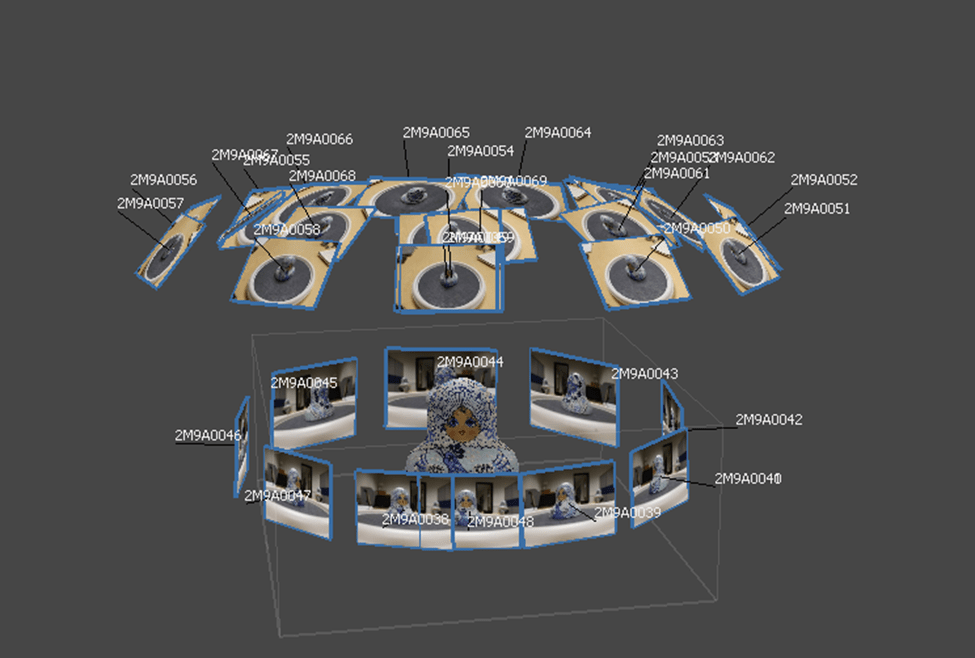
Process of Photogrammetry on a Lacquer Matryoshka Doll, Agisoft Metashape
And finally, to wrap up this blog post, I’ve selected one of the most fascinating Soviet posters I’ve encountered throughout my studies to encapsulate how I am feeling about this trip: “Другого дома нет!” or “There is no other home!”
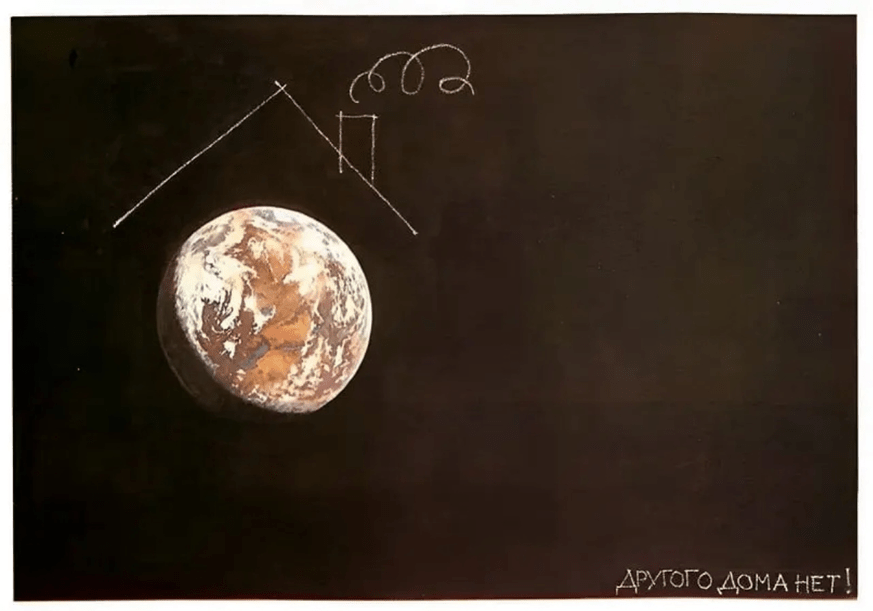
Другого дома нет!, Boris Andreevich Rogachevsky, 1986, USSR, Poster
And while the original meaning of this poster may have had a very different, intentional message (to my knowledge it is about environmentalism), my interpretation and personal relation to this poster is that even though my nerves and anticipation for this trip may sometimes lead me to believe that Riga will be an overwhelmingly different and confusing place, we are all humans at the end of the day living together pursuing happiness; and that no matter where I am, I will always be able to find kind and joyful people that make it all worth it!
Thank you for reading, and until next time!
 HSF House Blogs