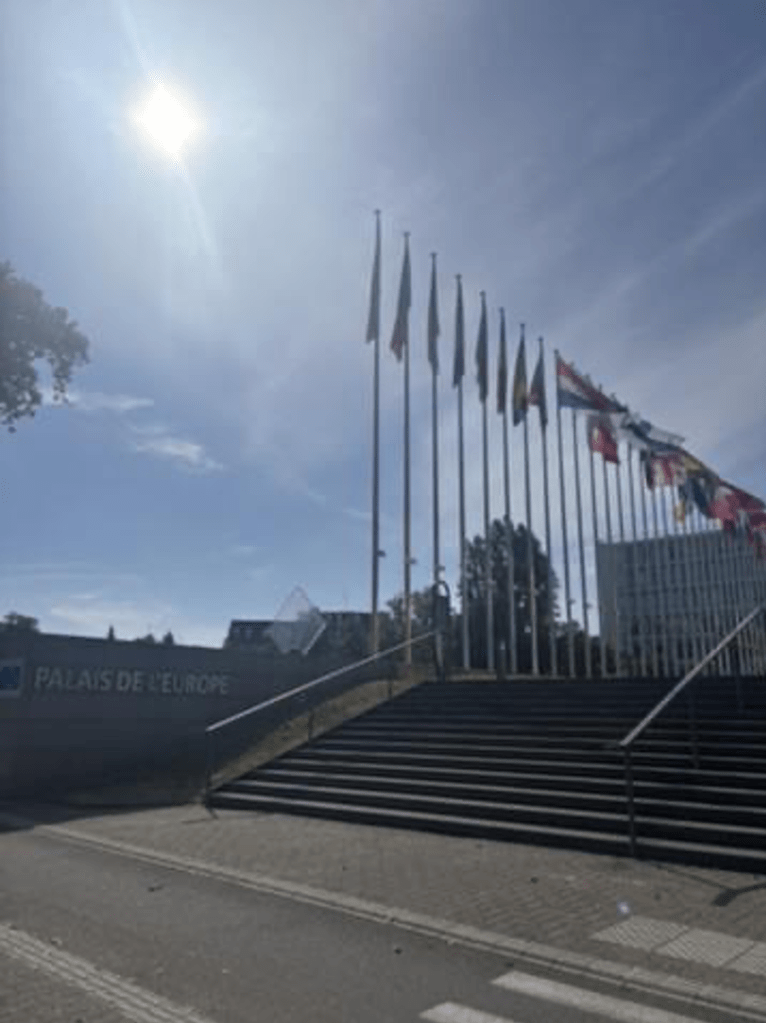
Palais de l’Europe – Main building of the Council of Europe, where I pass by everyday on my way to work.
By Maria Clara Sandoval Durski
This summer, I am pursuing an internship at the Council of Europe, specifically in the department that oversees the European Social Charter.
As part of the Global Scholars program, I am not only getting professional experience abroad, but also critically engaging with the topic of social rights through my capstone research project. By combining my internship and my capstone project, I aim to answer the following question: How are social rights perceived and prioritized across different regions in Europe?
At the core of this issue are diverse stakeholders. Directly, there are European institutions such as the Council of Europe, the European Court of Human Rights, and national governments. Then, there are the affected communities, which are the European people, but primarily marginalized groups such as migrants, ethnic minorities, and low-income families.
My interest in social rights norms comes from a more broad concern over the gap between rhetoric and action by powerful global actors. Growing up in Brazil and now studying international affairs, I have seen how policy ideals can diverge from practice.
As someone whose academic and professional focus lies at the intersection of diplomacy, development, and law, I am approaching this internship and research project aware of my own developed assumptions. It is my belief that social rights promotion should be about tangible results and not just optics.
So far, much of the information I encountered emphasizes the EU’s role as a normative power. It claims to be a leader in global social rights and wants to solidify its ideals through diplomacy.
The perspectives that are sometimes missing from this discourse are those of the people these policies affect.
I want to understand not only how social rights are written into agreements, but also how these agreements impact everyday people.
When it comes to the four roles of social change, I most often see myself as the Advocate. I am most effective when trying to change things from within the constraints of the system and having that act as a jumping off point for those who are organizers and rebels. I like to think my work in the future will lay the foundation for change, because without a foundation, backsliding is much more likely to happen.
 HSF House Blogs