By Maya Parfitt
Hi, my name is Maya Parfitt and I’m a rising junior at the College of William & Mary. I’m a student of Ancient Mediterranean Archaeology and Art History, and I feel incredibly lucky to be a Tyler Fellow. This summer, I’m doing research in Greece as a student team member of the Naxos Quarry Project (NQP). I’m excited to tell you more about myself and my work.
Ever since I was little, I always knew that I wanted to be an archaeologist. I was born in Bulgaria, and many of my childhood summers were spent visiting my mom’s side of the family in Varna. Ancient ruins are so ubiquitous there that she and my uncle played in the remains of Roman baths as kids. My early exposure to all the layers of history – Thracian, Greek, Roman, Christian – in my birthplace sparked a profound interest that never went away. When I made it to college and took courses in the Classical Studies department, I realized that this field is about far more than finding treasured objects. Often, people go unremembered in the historical record if there is no written account of them. That’s why material culture is so important – it’s the physical imprint of one’s existence.
Another big part of my childhood was spent on construction jobs with my dad. Before he retired, he was like any other American, blue-collar worker. I saw him do all kinds of projects – big and small – from fixing the hinges on a door to remodeling an entire local bookshop. My dad, one of the most ingenuitive and hardworking people I know, is rarely acknowledged when passersby gaze at the bookstore he renovated. While they may appreciate his handiwork, they may never know his name, how he did it, or anything about his life. But there’s plenty of crown molding and wooden shelves to prove that Jeff Parfitt was there. And one of the benefits of life today is that we keep records of almost everything, so gaps can be filled easily.
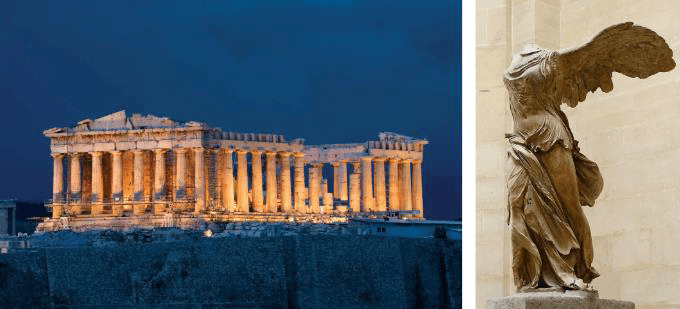
Left: The Parthenon on the Acropolis, Athens (credit: iStockphoto/Thinkstock). Right: The Winged Victory of Samothrace displayed in the Louvre, Paris (credit: Tory Brown).
It’s not so easy for antiquity. One of the hallmarks of ancient Greece is marble. The first things we think of when this civilization is mentioned are iconic monuments like the Parthenon or sculptures like the Winged Victory of Samothrace. But little is known about anyone involved in their creation besides architects, artists, and sometimes patrons, despite the clear importance of marble and its heavy usage in the Mediterranean world. Where did this marble come from? How was it extracted? And, most importantly, who made it possible?
The island of Naxos, extensively exploited in antiquity for its renowned marble quarries, may provide the answers. I was first introduced to Naxos after assisting my current research mentor, Professor Jess Paga, who specializes in Greek monumental stone architecture. Through my work with her, I started to wonder about the everyday people that labored to extract marble in Naxos’ quarries. The lack of scholarship on them was unsurprising to me, since ancient Greek sources tend to favor the elite. I was eventually asked to be a part of the NQP, which will give me an opportunity to explore my unique interest in the lived experiences of Naxian quarry workers.
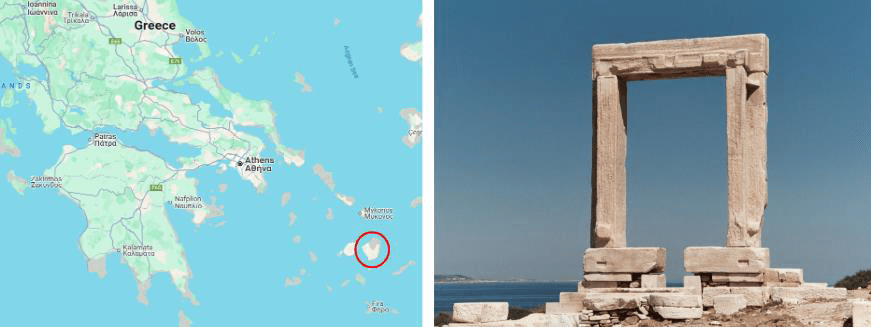
Left: Map of Greece with Naxos circled in red. Right: Ruins of the Temple of Apollo on the island.
Broadly, the NQP will investigate the remains of a colossal marble block from the island’s Melanes Quarry, abandoned in antiquity. Through detailed documentation and analysis, our aim is to discover where in the quarry the block was found, its intended function, and why it was abandoned. My hope is that retracing the origins of the block will also illuminate the techniques and experiences of the laborers who made it possible. I will be spending ten days on the island with a team of international, multidisciplinary researchers, who specialize in subjects like geology, botany, landscape and topography, aerial and LiDAR, quarrying, architecture, sculpture, and ceramics. I’m particularly excited about this archaeological work because in addition to using the traditional field methodologies I’m familiar with, we’ll also be employing innovative ones like LiDAR, photogrammetry, and digital modeling. After working on Naxos, I will travel to Athens for ten days, processing data and finds from the island. In addition to that, I will perform archival work in both the Blegen Library at the American School of Classical Studies at Athens and the library at the German Archaeological Institute. Specifically, I will comb through records and publications related to Naxos and its marble as well as pieces on subordinate or subaltern experiences in ancient Greece.
The culmination of my research will be similar to a virtual museum exhibit. Using ArcGIS StoryMaps, my goal is to make a website that leads the viewer through evidence of the quarry workers’ existence, such as tool marks and signs of settlement. It will be riddled with maps, drawings, and photographs. Additionally, I hope to reconstruct a sensorial day in the life to help viewers get a feel for the embodied experience of an average Naxian marble quarrier. I will also include a section about the broader implication of my findings on ancient Mediterranean marble quarrying. This work will be challenging, and I’ll have to be meticulous and nuanced with the way that I represent information gained from the NQP. I want to make sure that I do these workers justice, because without people like them, we wouldn’t have the marble architecture and art that has shaped our world.

