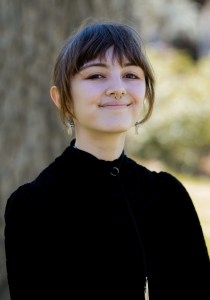
Hello everyone! My name is Audrey Lendvay, and I am a second year studio art student at Florida State University, and I now have the exciting honor to introduce you all to my upcoming IDEA Grant research for summer 2024.
My project takes a particular interest in the ways in which we participate in physical and virtual spaces, and with how virtual worlds might be capable of connecting participants to their own lives and enriching their own sense of place and mindfulness. I will be recontextualizing the “dérive” in video game spaces, a concept originally developed by Guy Debord in the 1950’s as a creative mode of exploring urban spaces that is in communication with the physical attributes of the location. In my gamescape dérives, I will set aside the expectations and delineated paths of the game to examine the structures and sensory inputs that engage me, and the images collected on these explorations will become the basis for the second part of my investigation.
Using the aforementioned images as my guiding force, I will then gather images from my physical surroundings. Just as I disregarded the imperatives of each game I played, I will break from my daily routines to wander free, adrift with only the goal of engaging my surroundings in purposeful exploration and visual play as I seek compositions that meaningfully resemble the ones I found in another artist’s virtual space.
At last, I will reflect on my virtual and physical encounters as a series of six oil paintings in three pairs, using the traditional medium to elevate ordinary life scenes and challenge notions of the “low” art of video games, metamorphosizing them into extraordinary sites of mindful play and interdependence.
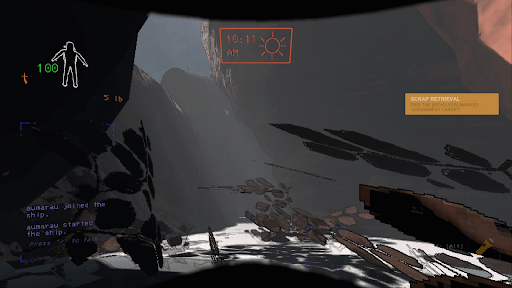
Not long after receiving my grant offer, I had already begun conducting my gamescape dérives. I started with the cooperative game I’d played most with my friends lately, Lethal Company. Prior to this investigation, I hadn’t even been certain if the game would accommodate a single player game, and once I successfully loaded into the game alone, I right away began noticing creative features in the landscape and architecture that I had always been too preoccupied to see before. For a game whose reputation almost exclusively praises its capacity for horror and comedy, it became apparent to me that the developers cared as much about composition, atmosphere, and color. Within a day and night cycle in Lethal company, these creative variables are constantly in flux as the sun follows an accelerated path around the moon on which the player explores, creating nearly endless potential for constantly changing compositions. I found my new mode of exploration to be immensely pleasurable, and I expect it will impact the way I navigate these maps in future games.
I enjoyed my Lethal Company dérives, however I wasn’t wholly satisfied with the images I had collected. The game’s graphics possess intentional low fidelity, making for fascinating landscapes but omitting a great deal of detail. Subsequently, I took my investigation to one of the most detailed virtual worlds I had access to, the Wasteland of Fallout 4. My farthest progressed save file was set to a difficulty that prevented the use of fast travel, so I set about researching developer commands I could use on a new save to travel with greater ease. This obstacle led me to my most exciting development yet- the ability to turn off in-game collision. Now, my character was essentially immaterial, capable of passing through any item, wall, or floor as if it did not exist. This feature enabled near limitless exploration, except for beyond the invisible boundaries that lay at the very edges of the map, sky, and underground. I believe that these dérives have yielded my most interesting compositions yet, fragmented landscapes with impossible representations of a damaged natural world.
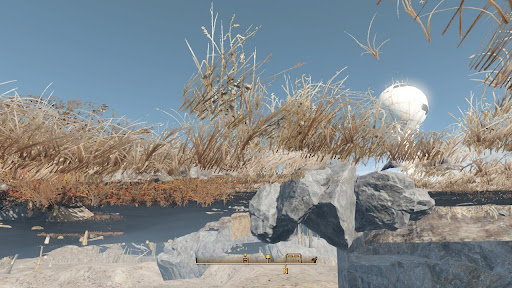
I am presently curating and preparing some of my Fallout 4 screen captures for small studies before I begin my larger paintings. I am now especially interested in exploring ways that I might be able to produce similar visual results with the photos I will take in physical space. First, I intend to experiment with a java script I had organized on the p5 online editor to create a series of artworks called Kaleidoscopic Overload. These images were born from an investigation into the functionality and energy costs of NFT’s, as well as the energy landscape of Florida, and I would like to explore coding composite compositions like this further.
 HSF House Blogs