Hi, I’m Morgan Krause, a junior at Florida State University majoring in Environmental Science and Policy. I’m preparing for law school with the goal of pursuing a career in environmental law. Through this blog, I hope to share my research journey, provide insights for fellow student researchers, and inspire others to explore the intersection of environmental science and policy. Many of my friends describe me as someone who can’t stop moving, pursuing new projects any chance I can get. Most recently, I have been pouring my energy into my Honors in the Major thesis project, centered around the community of Apalachicola, Florida. Strengthening this research, I was chosen as a recipient of the Bess. H Ward Honors Research Award in the fall and in the last couple of weeks, the Robert and Mary Frappier Undergraduate Research Award through FSU’s IDEA Grants program. It is an honor to accept this award and I am truly elated to strengthen my current project through the IDEA Grant opportunity.

Getting started in my field of research began with a cascade of decisions and inquiries,
starting with my first time volunteering at FSU’s Coastal and Marine Laboratory (CML) in the summer of 2024. A friend invited me to join her in driving an hour and a half south to Apalachicola, Florida for a volunteer shift at a research facility owned by FSU. Not knowing what to expect, or that FSU even owned a lab on the coast, something in my heart told me I needed to go. During my first visit to FSUCML, I was entranced by the multiple murals painted on the sides of the little yellow buildings, feeling at ease due to my own love for painting.
As we stepped into the facility, two sensations immediately struck me. The first was the unmistakable scent of freshly harvested or thawed oysters—an odor I eventually grew accustomed to. The second was a sense of wonder, one that has only deepened over time.

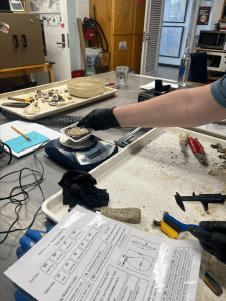
Within these little yellow lab buildings, I met scientists, researchers, and other dedicated members of the Apalachicola Bay System Initiative (ABSI). The team at ABSI is performing research to discover the root causes of the oyster population crash in Apalachicola Bay and working to develop management plans for the oyster reefs. During these summer volunteer shifts, my friend and I were taught how to perform the “full condition” of Apalachicola oysters, tracking certain data points like weight, width, sex, and more. We also helped build artifical oyster habitat using only rebar and zipties. The ABSI team later dropped these habitats into various sites in Apalachicola Bay for juvenile oysters to attach to.
As we performed various tasks, I found myself most interested in the discourse between the scientists around me. Specifically, I became fascinated by their detailing of the interactions between the scientists and the community. They discussed a growing tension between the two bodies, two groups of people who, from my understanding, want the same thing: a healthy Apalachicola Bay (henceforth known as, the Bay). My curiosity grew and I started to bring a notepad to my shifts, taking notes as they answered my questions about the oyster population crash and local community. One particular day, a scientist mentioned that we needed to be careful wearing FSU branded clothing when in Apalachicola, as they have received backlash for doing so, being that FSUCML is dedicated to restoration work. Many residents blame the scientists for the moratorium on oyster harvesting in the Bay, leading to minor violence, such as the slashing of tires, verbal threats, and more. This particular conversation is really what motivated my research project as I empathize with both the scientists and the residents in this situation and ultimately want to uncover the cause of the tension and explore ways to bridge the gap between the two groups of people.
In order to fully understand the residents’ frustrations, my research aims to uncover the socioeconomic implications of the oyster crash on the Apalachicola community and apply these impacts to potential future outcomes. For example, due to the oyster crash, the place of oyster harvesting in the generational heritage of many Apalachicola residents has dwindled greatly, and while the Bay used to be a source of income for many, Apalachicola is now reliant on an economy based in tourism (92%). There is anecdotal reporting of youth
out-migration in Apalachicola due to a lack of job opportunity, resources, and adequate education. Paired next to each other, these facts about the Apalachicola community could be correlated, as it is a possibility that those who have out-migrated may have chosen to stay if oyster harvesting was still an option. This is just one example of the trends I will be investigating this summer as a part of both the IDEA Grant opportunity and Honors In The Major program.
Using semistructured interviews, thematic analysis, historical record, and other reporting, my goal this summer is to highlight the impact of the oyster crash on Apalachicola and Franklin County. I hope to inspire restoration and management plans that engage the community and represent all of those who have a stake in a healthy and thriving Apalachicola Bay System. As humans collectively benefit from a healthy environment and face significant challenges when it is degraded, I believe that we all are stakeholders in the well-being of our planet. I look forward to applying this deeply held belief as I investigate a rural, vulnerable, coastal community this summer.
 HSF House Blogs