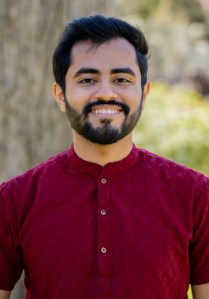
Hello! My name is Jas Chawla, and I am proud to be part of a team to have received an Idea Grant. To be honest, I was one of the people who majored in computer science because it was what all my friends were doing. In fact, my original plan was to major in Finance. I must say, changing my major right before my first college algebra class was one of the best decisions I have ever made.
Eventually, I felt the need to challenge myself beyond what my classes offered. That’s when I dropped a message in a group chat: “Anyone else interested in AI?” Not long after, I received an invitation to join MLab.
MLab is where I gained experience in drone programming and developing products for real-world consumer use. In the lab, my team and I created an app to help elderly patients relax while getting medical treatment. We utilized both AI-generated and recorded assets to build the app, which helped reduce costs and gave me insights about using, what was at the time, cutting edge technology.

Beyond the technical skills, it helped me see computer science as more than just “making a computer do stuff.” It showed me the kind of community that forms when like-minded people come together with a shared goal. Looking back, MLab likely played a big role in why I want to work at a startup someday.
Now I am a passionate tinkerer with a knack for competition. My first engineering competition was the “Guardians of the Grid” hackathon. My friend asked if I would be able to team up for the competition, I wasn’t busy that day, so I decided to join him. Even though he didn’t show up, I found myself a competent team who I collaborated with to create a Concept which won us second place. Since then, I have traveled the country with the purpose of attending different hackathons.
Eventually, I signed up for Hack Disaster, a collaborative hackathon between Florida State University and Taras Shevchenko National University, a Ukrainian university. Since I’ve been deeply invested in Russia’s invasion of Ukraine and am aware of the destruction caused on Ukranian cities, I saw this as a chance—even if only a small one—to contribute to an issue I care about. Hack Disaster is where I joined a team, including Amber Losciale, to create a drone damage assessment model—the very model that became the foundation for our IDEA grant project.

Now, for how the damage assessment model works. It combines a segmentation model to estimate the number of damaged buildings in an area with a YOLO model trained on side-view images of buildings for a more definitive cost prediction. I’m sure I don’t need to spell out the numerous potential issues with this approach, but the hackathon was more focused on proof of concept—which seems solid.
We believe this approach can be refined by training a YOLO model with more labels, incorporating actual material costs, and leveraging more complex algorithms to develop a fully functional system for real disaster response. While creating such a system won’t be easy, IDEA Grants funding will make it far more feasible. We also hope to gather real-world field data to present at a conference.
 HSF House Blogs