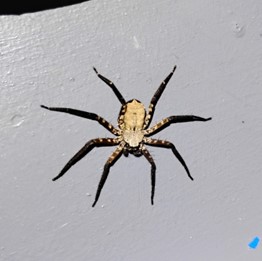
The featured image above is a flatty spider (Selenops insularis) that the author found on a invertebrate collection trip this July down to the Florida Keys.
I am thrilled to share my project at the President’s Showcase, as it offers a unique opportunity to share what I have learned about the fascinating world of venom variation and its connection to understanding evolution and sex determination in scorpions. My research focuses on the Florida bark scorpion and aims to uncover the genetic basis of venom variation, a topic that has broad implications for our understanding of evolutionary biology and the impact that sex determining mechanisms can have on phenotype.

Venom is a critical tool for survival in many species, but what makes it particularly intriguing is how its composition can vary so significantly, not just between different species, but even within the same species and between sexes. This variation is likely tied to evolutionary pressures and could provide insights into how different sexes adapt to their environments in unique ways. I hope to show people just how incredible these animals are and how this research isn’t just about venom; it’s about understanding the broader principles of evolution and adaptation.
At the Showcase, I hope to communicate the importance of this work to my fellow researchers and the public. For my academic peers, I want to highlight how venom variation can serve as a model for studying evolutionary processes. The differences in venom composition between male and female scorpions, for example, may reveal how sex-specific traits evolve and how these traits contribute to the overall survival and success of a species. Additionally, this research can provide valuable insights into the genetic mechanisms that drive sex determination within scorpions.
For the public, I aim to spark a curiosity about the natural world and how seemingly small details, like the composition of venom, can have significant impacts on the survivability of a species. Understanding these mechanisms can also shed light on broader questions, such as how organisms adapt to changing environments, that people would not normally think about. I also hope to share my love for these misunderstood and often feared animals. While they may be scary and even deadly at times they are incredibly complex and intriguing creatures that play a vital role in their ecosystems. By sharing my research, I want to inspire others to think about the complexities of nature and how everything plays together to form the organisms that we see today.
In addition to contributing to scientific knowledge, this project has personal significance for me. As someone who has always loved venomous organisms, getting to share my love for these animals and the work that I have put into trying to understand the venom of one of these species is an incredible opportunity and I simply cannot wait.
 HSF House Blogs