Hello! As the President’s Showcase gets closer, I am looking forward to presenting my work on this project in the same place that it started. When I first began as a UROP student, I was completely unfamiliar with soils and environmental science. I struggled to understand the context of the results I would obtain, and the importance of the systems we were focusing on. Two years later, I am excited to share what I learned as a student and as a researcher in a way that is approachable for the public and informative to other researchers.
Although stable isotopic analysis sounds very “fancy” for lack of a better word, the actual concepts behind it can be easy to understand. Put simply, plants take in carbon to grow, and that carbon comes in two stable types that only differ in weight. Most plants prefer to pick the light version from the air around them. Other plants can hold some air and take up all the carbon in it, heavy and light. When a plant is eaten, the animal that eats it uses the carbon that the plant captured, letting it keep the animal take the carbon ratio of the plants it eats.

Nitrogen also has heavy and light forms, but because of how it moves through the body the ratio of heavy and light changes each time an organism is eaten by another. For my samples, we want to look at whether the carbon and nitrogen from terrestrial, marine, or marsh plants are responsible for feeding oysters in different parts of the region. Understanding this can help us better understand one effect of the rivers on oyster populations. A popular theory about the causes of the 2012 oyster population decline in the region is that changes to the Apalachicola River may have contributed, so more information on the role of the rivers in the estuary is needed.
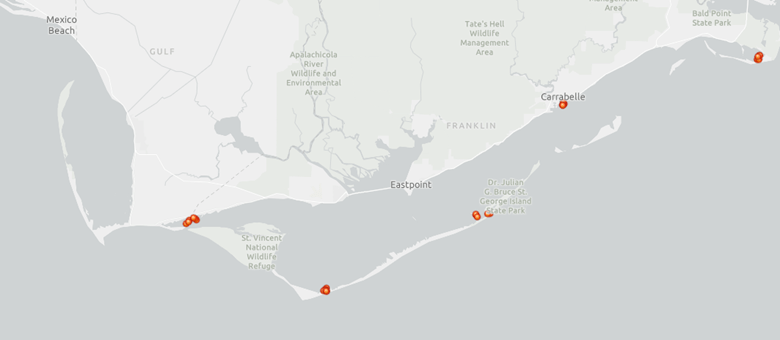
When providing context for my project, I am hoping to introduce folks who are unfamiliar to the ecological and economic circumstances surrounding oysters in Apalachicola Bay. As a keystone species, oysters have incredible ecological value beyond just their appeal as a meal. Their contributions to habitat creation, shoreline protection, and nitrogen cycling have been documented in studies around the world. Within the Apalachicola Bay region, these oysters also functioned as something of an economic keystone, providing jobs for communities along the coast such as Carrabelle, Eastpoint, and of course Apalachicola. Without the benefits from local oyster populations, these human communities have been affected just like the ecosystems that once supported their livelihoods. Although my work is not focused on understanding the effects of the population decline on these people, I want to at least introduce this example of the human consequences of these environmental issues.
 HSF House Blogs