As I made considerable progress on my research project throughout June and July, I spent a good deal of time reflecting on the potential impact of my research project, which explores the human and civil rights implications of data-driven and predictive policing practices. Being intentional about the impact of my project, both in and outside of academia, is paramount, especially because my research topic was inspired by injustices in my community.

Amidst the vast social unrest and economic uncertainty in the year 2020, residents in my hometown of Pasco County, Florida, were faced with anxiety beyond the rampant global pandemic and the inequality it heightened. This consternation was the result of our county’s predictive policing program– algorithmic technology that surveilled all Pasco County residents to predict future “prolific offender” criminals based on data including arrest reports (even ones that didn’t result in conviction), and disciplinary data from the public school system.
Read more about the “intelligence-led policing program” that has since been discontinued due to widespread controversy and a pending lawsuit: https://projects.tampabay.com/projects/2020/investigations/police-pasco-sheriff-targeted/intelligence-led-policing/
The images in this article, taken by Douglas R. Clifford, are particularly impactful as you read the stories of Pasco families that were harassed by law enforcement because of their status on the “prolific offender” list.
Since I originally began my efforts to study predictive policing as a human rights issue during my freshman year of college, my goal has been to raise awareness of the issue and advocate for increased legislation to govern novel surveillance and algorithmic technologies with the potential to perpetuate state-sanctioned abuses. This is a goal rooted in my mission to stand up for the human rights of all people, never being a passive agent when witnessing persecution. The closeness of this issue to my own life has amplified my desire to keep fighting for its importance. Academically, I hope to fill a gap in the literature surrounding predictive policing programs by offering a multidisciplinary analysis of the explicit and implicit ways in which predictive and data-driven programs may improve policing, reduce crime, and/or lead to surveillance that infringes upon human and civil rights.
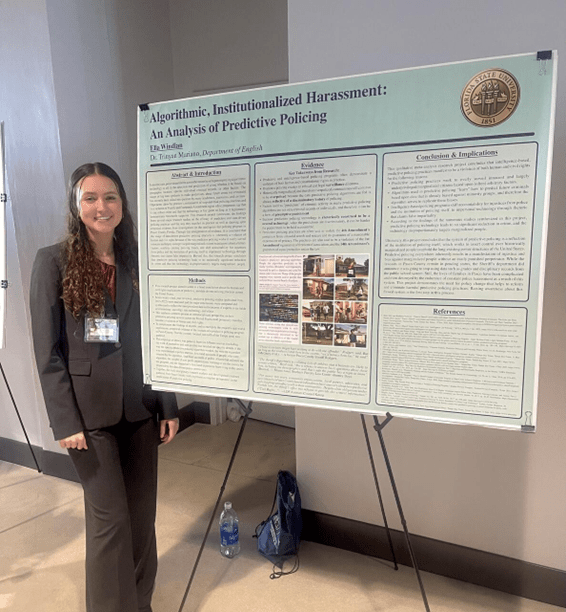
Throughout the past eight weeks, I have dedicated the vast majority of my time to studying predictive policing in all of its manifestations through a multidisciplinary and human-centered design. The next month represents a change in my routine, as I will be studying human rights and genocide with a cohort of FSU students primarily in the Czech Republic. Focusing on the fundamental documents that set the standard for global human rights will help to strengthen my conclusions about how predictive policing and similar technologies may violate them. During the final two weeks of my summer semester in August, I will focus on applying what I learn about human rights history and theory in the next month, to my project to draw my preliminary conclusions as I transition this project into my Honors in the Major.

 HSF House Blogs