
The initial title for my project was as ambitious as much as it was a mouthful. “The Scourge and Submissive: Powerplay in the Face of Self Harm and Anti-Sex Feminism.” One part of this title has since been reworded for clarity whereas the other removed entirely. It was already a challenge to try and posit “anti-kink” rhetoric as some great threat to bodily autonomy, much less adequately explore the role of modern attitudes on trauma victims.
“Intersectionality” is a favorite term amongst scholars and online activists alike. It’s useful for describing the distinctions between different groups of people’s experience with any one subject as it relates to their various social, political, or racial identities. While kink and its different forms are as broad as the sorts of people that engage with them, the scope of my writing was intentionally limited to the common experiences of women attracted to men. Ideally, the paper would also address the initial title’s mention of “Self Harm” in the way some participants’ female identities can drastically alter how their engagement in BDSM is perceived. Although I had hoped to also speak on the experiences of women who had endured traumas seemingly related to their sexual expression, I had come to the conclusion that doing so would require the sort of coverage a twenty page essay couldn’t properly convey.

That was until I reached an impasse with my own writing. It proved unfeasible to give an authentic or even moderately censored depiction of many women in kink without discussing the traumas that either occur before or in tandem with their participation. In doing so, it almost felt like whatever contribution I would have towards this conversation would just be feeding the bad faith arguments of my opposition. Much of the current discussion I’ve seen on this topic reveals a hostile underlying attitude to female participants of kink, particularly those who may have suffered sexual or relationship violence. Those dissenting to their involvement in kink may call their mental capacity for consensual activity into question, asking if they can really participate with a sound mind. Thus, for a woman with any sort of unsavory history to participate may seem like the encouragement of self-sabotaging behaviors.
As one can hardly hand over their psychological evaluation to any one of these voices, it becomes an impossible debate. It’s tempting to want to frame your counterargument to any of these positions as elevating the mental wellness of the female participants, as if to say, “See! We’re actually all perfectly healthy and safe!” It would be a loud and polarizing approach, potentially stirring up more discussion on how many assumptions we can actually make out of each woman in the BDSM community. Both my time writing and collaborating with my mentor has convinced me of the futility of this position, however.
To live as a woman often feels like a desperate attempt to justify any action done outside the norm as morally defensible. We are consistently interrogated by men, yes, but other women too about behavior perhaps unbecoming of our supposed feminist identity. This latest discourse where female trauma victims are questioned for their involvement in BDSM feels like another attempt at discrediting women out of feigned concern. In the not-so-distant past I may have been ready to dismiss arguments such as these as lacking any content worth discussing, but now it has presented itself as the new core for my project. It’s difficult for anyone to deny that women are almost predisposed to certain types of exploitation, sexual or otherwise.
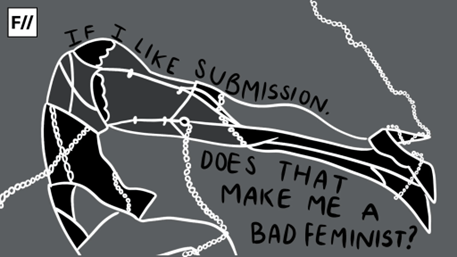
Thus, most would feel confident in acknowledging that by adulthood, when we are all legally able to make our own bodily decisions, the majority of women have suffered some form of trauma. This of course includes those who may later choose to get involved in kink, but also any other woman pursuing supposedly “good” goals, such as motherhood. We cannot say for certain if a new mother in this time has arrived at her choice wholly uninfluenced by trauma or societal pressure related to her gender, but it’s hardly anyone’s business to question her on that front. Meanwhile, the woman who involves herself in kink must be braced for a barrage of scrutiny.
There was a study conducted over a decade ago that revealed BDSM participants to be slightly more mentally well-off than their “vanilla” counterparts. Still, stigmatization persits. So, while there may be immense satisfaction in waving the results of this study in the faces of those who condescendingly imply the reduced intellectualness of female kinksters, it is not likely to kill off discourse entirely. Just the same, a more staunch and combative tone in my own piece will not guarantee any real response from readers who may have already formed their opinions.
As the desire to patronize women’s choices has seemingly proved more influential than the science to support their right to make them, I have understood that my project’s goal cannot be to dismantle this line of thinking. Instead, now nearing its trimming phase, my piece has taken on a position I might have called cynical in the past. It’s not so much concerned about listing off the various reasons anti-kink feminists are wrong as it is trying to honestly engage with the narrative my opposition has referenced, that of the damaged girl turning to kink as a self-sabotaging activity after suffering some great pain. Certainly, this woman exists, as to deny her existence would be to deny the pain inherent to womanhood itself. That is to say, my paper now aims to ask “So what?” Are we now doomed to second-guess our every decision as being tied intrinsically to the burden of womanhood, or do accept that, and live anyway, somehow finding pleasure in a society almost intent on giving us a hard time regardless of what we do in the bedroom?
My piece will hardly be the first and certainly not the last to offer this slightly grim though personally comforting perspective. The goal, if anything now, is to touch the lives of other women who may have doubted their capacity for agency after being subject to the abuses we face in a patriarchal world. As unwilling players in a game often rigged against us, it is only fair that we find ways to enjoy the time that we do have rather than appealing to disapproving perspectives. With any luck, my writing will resonate with that audience and give them the assurance to make their own decisions, regardless if it’s in line with my own stance.
 HSF House Blogs