Already, I have been surprised by how the results of my research have begun to guide changes to the form of my project. Since my last blog post, I have spent the most time developing a small program that generates frame looms for weaving that have varying, random characteristics, which may end up becoming the focus of my finalized works. I have become increasingly interested in understanding an interplay between pattern and randomness as the force that shapes all systems. My interest in this idea comes from the first chapter of N. Katherine Hayles’ (1999) How We Became Posthuman, where she discusses the concepts of pattern and randomness in the context of cybernetics and information theory. I believe the pattern-randomness dichotomy can be used to understand everything at a very basic level.

All systems possess certain patterns—iterative behaviors that dictate their movement throughout the world. A system is arbitrarily in the presence of others that have patterns different from its own, and the interaction that occurs between a system and its surroundings imbues its being with an element of randomness. For example, plants have inherent patterns that they follow: its leaves are shaped a certain way each time they grow, but each one is slightly different because of the presence of other systems like weather, other plants, or the time of year. A similar situation occurs when a human makes a textile: these objects are typically created with geometrically perfect patterns in mind, but external happenings lead to slight anomalies and variations in the finished works.
When writing my frame loom program, I wanted to create an analogy for this pattern/random dichotomy. Typically, a weaving is created by wefting thread in a motion perpendicular to vertical, evenly spaced “warp” threads. However, I realized that if two sets of warp threads at non-right angles were placed diagonally over one another, it would create a diamond-shaped warp pattern that could still be woven upon, but in a much less regular way.
My code creates the outline of an irregular polygonal shape with a hollow center that has two pairs of warp threads (at random angles and with a random number of holes) that sit within the frame. This shape is laser cuttable and can then be warped and woven. I have just started to work towards a minor in astrophysics, and some newfound trig knowledge from beginning coursework for the minor allowed me to execute this idea.
To try the code out, see this link: https://nklusk.github.io/gemstonetester/ Each refresh of the page creates a unique frame.
I still have a bit of debugging to do, but it generates a functional object on most tries!
So far, I have fabricated and completed a weaving on one loom. Here is some documentation of that process:
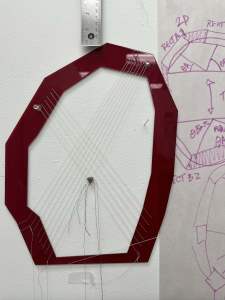
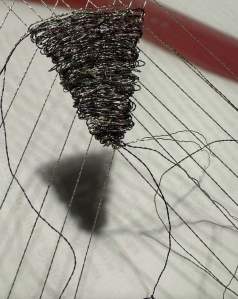
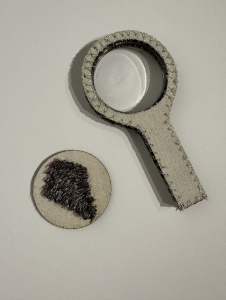
This initial weaving has acted as a trial run as I decide what role this new method will play in my final works. My next goals are to seek out materials to use in these weavings that are more reflective of my concepts than just thread and acrylic, to experiment with scaling the object up, and to work to make the looms more complex by modifying the code.
The process of weaving with such small thread was extremely time-consuming, so I need to find a more efficient material to use as weft thread. Additionally, I want to experiment with ways to make the actual process at work in the code more evident in the completed work. I also want to try leaving the weaving on the frame instead of removing it; the loom is just as important to the piece as the weaving, I realized.
The next challenge I face is finding a means of elegantly unifying my original inspirations of living plants and traditional textiles with this code creation into finished works. My initial loom test is far from a fully resolved work, and I seek ways to make the works more immersive and clearly representative of my concepts.
References:
Hayles, N. K. (1999). How We Became Posthuman : Virtual Bodies In Cybernetics, Literature,
And Informatics. University Of Chicago Press.
 HSF House Blogs
Hi Natalie!
Your project is super cool. I just started learning to code, while I don’t have any background in weaving, I’ve also been trying to see how I can use coding in my subject of interest. It sounds like you’re making good progress on your work, I hope it keeps going smoothly! Would you recommend “How We Became Posthuman”? I haven’t heard of it before but it sounds like a good read from your brief description.
-Sequoia Ernst
LikeLike