In the last month our team has transitioned from completing a prior project (a pedagogical essay to be considered for publication in a special issue of Eighteenth-Century Studies) to beginning the work on our podcast Sip & Connect – an exploration of Italian 18th-century sociability and Enlightenment culture. Each one of us has finalized and begun fleshing out our (respective) four research topics that will become the focus of our individual podcast episodes.

I have narrowed down the subjects of my episodes to include (in no particular order) the evolution of Italian opera, the discovery and excavation of Pompei and Herculaneum, the standards for manners and etiquette of the period, and an episode featuring an exclusive interview with author Susan Dalton regarding her book titled Gender, Mediation, and Popular Education in Venice, 1760-1830 (2023) (pictured to the side).

My exploration of the evolution of Italian opera will primarily focus on the 18th-century developments, including the emergence of the two primary styles of Italian opera: opera seria and opera buffa. I plan to include a thorough discussion of the dominant and most influential composers of the period as well (focusing on the Neapolitan opera scene).
In my episode on the discovery of both Pompei and Herculaneum, I intend to tell a vivid story of the gradual excavation of both sites (excavation that took decades to complete) and in doing so, help listeners understand the development of both modern archeology and art history.
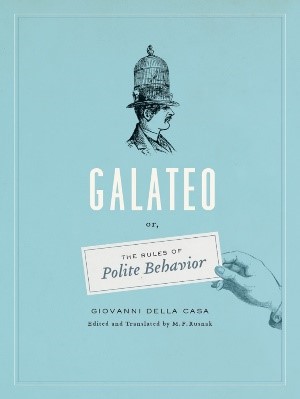
My investigation into the standards for manners and etiquette of the period will reveal much about the Italian self-concept and the importance of appearance in their story. Much of what I discuss will be pulled from Galaeto: The Rules of Polite Behavior by Giovanni della Casa (1558) (pictured to the side). This episode will intend specifically to expand the listener’s understanding of Italian sociability and build a picture of the standards for interactions in this period of Italian society.
The final episode of my contributions to the series will center around an interview with esteemed author Susan Dalton. Her book in question is one of her most recent publications and establishes her position as an expert on the role women played in 17th/18th-century Italian society and the relationship between their private and public spheres. Given that her work was incredibly important in the development of my UROP research on the topic, I am thrilled at the opportunity to discuss the subject with her.
Upon clarifying exactly what topics I will be pursuing, I have begun reviewing sources to accumulate the research required for each episode’s script. The greatest challenge I have encountered so far in my work has been the selection of sources. Because such abundant written material exists on these topics, I must clarify the trajectory of my discussions and choose sources accordingly. I imagine that the outlining of my discussions (including crafting respective theses) will be the largest hurdle to the completion of my work this summer. Luckily, this is a familiar problem, as it was one that I also encountered while developing an introductory podcast episode for UROP. Given that my research mentor, Dr. Zanini-Cordi, is an expert academic in this subject matter, the clarification of the themes of my discussion and subsequent selection of sources becomes much easier with her guidance.
Transitioning from thorough focus on a singular idea as a part of my UROP work to the exploration of many topics of my choosing has been very enjoyable. I am incredibly excited to continue investigating these subjects and anticipate many thematic conclusions for next month.
 HSF House Blogs