Hello, Reader!
My name is Ana Carolina Pereira, I’m a first-generation Brazilian-American, born and raised in Miami, Florida. I’m a 3rd-year Physics major at FSU, as well as an FSU ACE Tutor for introductory physics, chemistry, and math. I was recently awarded an IDEA grant for my Summer 2024 research under the guidance of FSU’s Dr. Vandana Tripathi.

If you’re like many FSU students, you probably read that I was doing physics research and assumed that I would be collaborating with the National High Magnetic Field Laboratory (MAGLAB) on FSU’s engineering campus. However, my physics field of interest is nuclear physics, and we have an extremely sophisticated experimental facility on FSU’s main campus: the John D. Fox Laboratory. Nuclear physics is the branch of physics that studies the properties and behavior of atomic nuclei, which are the central cores of atoms. This field focuses on understanding the fundamental forces and interactions within atomic nuclei, such as nuclear reactions, radioactive decay, nuclear fission, and nuclear fusion. Nuclear physics plays a crucial role in various areas, including energy production (such as nuclear power), medical applications (like radiation therapy and imaging), and astrophysics (studying stellar processes and the origin of elements).
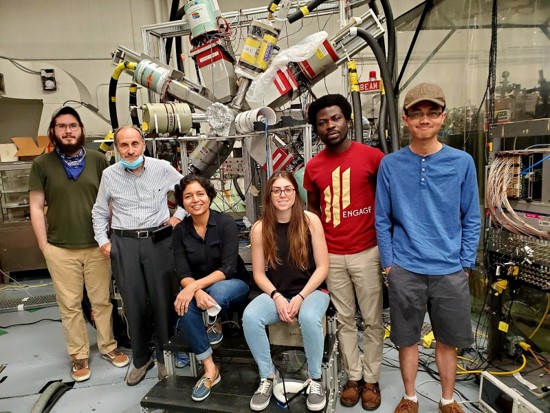
The motivation of my IDEA grant project is to determine a relationship between the mass and angular momenta of the nuclei fragments produced upon spontaneous fission. I am performing this analysis using the data which depicts the spontaneous fission of 252-Californium measured by Argonne National Laboratory’s Gammasphere. The data recorded is converted to a gamma ray spectrum: I can project any time interval of 1 microsecond and analyze each of the gamma rays emitted within the chosen interval. Gamma-rays released within an interval are highly likely to have been produced by the same nucleus. Gamma-rays and the order which they are emitted are characteristic of different nuclei.

Using the Evaluated Nuclear Data Structure Files (ENDSF), I can categorize gamma rays consistent with those known to be emitted by certain nuclei and thus identify a fission fragment. To measure angular momentum correlations, I will analyze the angular distribution of directions in which fission fragments and/or gamma rays were emitted upon the reaction and discern the corresponding nucleus of each momentum measurement. Understanding the relationship between these two properties could provide insight into the mechanism of fission: such as exploring what drives a nucleus to divide into different fragments each time as opposed to remaining consistent like other decay types.

I hope for this project to develop into my Honors-in-the-major thesis. As of now, my thesis is to include discussions of methods and the importance of maintaining an accurate database which experimentalists might use for characterization of nuclei, in addition to a continued and more specific investigation of the data I will dissect this summer. I hope to obtain my PhD in Physics at a university with a strong nuclear physics department, such as Michigan State University, UC Berkeley, Stony Brook University, or UNC Chapel Hill. I want to study the practical applications of nuclear physics in steering our society away from dependence on current, non-renewable energy sources. Then, I will pursue a tenure-track professor position at a research university that collaborates frequently with a national laboratory that focuses on nuclear physics, such as Brookhaven or Lawrence Livermore National Laboratory. The IDEA grant will be a monumentally helpful tool to best prepare myself to be a successful experimental physicist and instructor.
 HSF House Blogs
One thought on “Striving to Better Understand Gamma Rays and Nuclear Physics”