Hello! My name is Erin Tilly, and I am currently a junior at FSU studying Biology and Environmental Science. Over the past year, I have had the opportunity to work with the Breithaupt BioGeoChemistry Lab on a project focused on assessing intertidal oyster reef functionality in Apalachicola Bay. I am honored to be a recipient of the 2024 Helen Louise Lee Undergraduate Research Award and for the opportunity to expand my current project!

The Apalachicola Bay oyster fishery once produced 90% of Florida’s oysters, but populations declined in 2012 due to a combination of factors and have not recovered. The oysters harvested from subtidal reefs in the region created the economic foundation of coastal communities in Franklin County, so most efforts to research and restore oyster reefs in the area have focused on these reefs. Because of this focus on subtidal reefs, or reefs that can be harvested commercially by dredging on ships, less attention has been paid to intertidal reefs in the region. These intertidal reefs contribute to things like nutrient cycling, shoreline protection, habitat provision, and more; but their condition has not been extensively studied like that of subtidal reefs. To address this, our lab created a project within the Apalachicola Bay Systems Initiative (ABSI) focused on evaluating the condition of these reefs at five major sites across Franklin County.

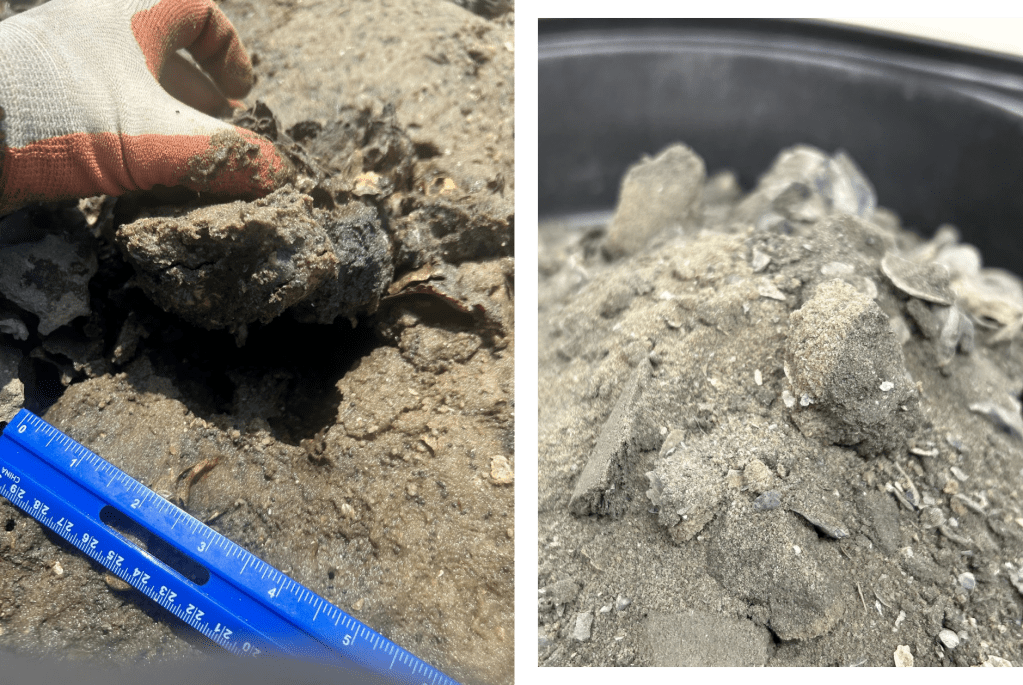
This project also aims to evaluate whether oyster shell clusters and oyster reef sediments can be an effective tool for monitoring reef functionality. Traditional methods of monitoring reef condition require researchers to break off live oysters from the shell clusters they grow on, disturbing the reef and removing individuals from a battered population. While this method can provide invaluable data on the state of oyster populations, the method we are testing may allow us to measure the clusters themselves without degradation. Furthermore, because oysters deposit their waste into the sediments that make up the reefs beneath them, we can gather data that may help us to better understand the condition of oyster reefs as a functional part of a larger system rather than just a platform that grows, an admittedly delicious, seafood.

With the funding provided by this grant, I will focus on determining whether the origin of organic material deposited on intertidal oyster reefs is primarily terrestrial or marine; and whether the composition varies by location within the region. Terrestrial and marine organic material can be distinguished through stable isotope analysis of sediment organic carbon and nitrogen. One factor that is thought to have contributed to the 2012 population collapse was a series of severe droughts that reduced the flow of the Apalachicola River and the organic material brought into the bay from the floodplain.

Depending on the findings of this study, identifying reefs influenced predominantly by marine waters and the organics within them may help identify sites for restoration that will be more resistant to the adverse effects of droughts. Isotopes are forms of elements that differ only in mass, due to varying numbers of neutrons. Because they only differ in mass, different isotopes of the same element behave equivalently in most processes. Still, some processes, such as carbon fixation during photosynthesis in most plants, prefer to use the lighter isotope. This alteration of the abundance of isotopes in a product relative to the source is known as isotopic fractionation, and the degree to which the ratio is changed is known as the fractionation factor.
For carbon, 13C fractionation factors in photosynthesis are species and environment-specific and can act like an isotopic “fingerprint.” Because carbon is not significantly fractionated during predation, the “fingerprints” of the photosynthetic species in an organism’s diet can be measured even after the carbon has been assimilated. For nitrogen, 15N bioaccumulates, resulting in the highest trophic levels being the most fractionated. Using both of these “fingerprints,” we can identify the environments most associated with feeding these oysters, potentially identifying factors that may be influencing reef condition.
 HSF House Blogs