Hello! My name is Emmie Bryson. I am a multimedia artist pursuing a degree in the BFA Program for Studio Art and a minor in Art History. But most recently, I am the recipient of an IDEA Grant! As an artist (and overall human being), I would describe myself as a storyteller obsessed with the past. My choice of media: drawing, painting, sculpture, performance, and fibers reflect this, with materials that act as artifacts or inspiration for these ideas. It is the marriage of these interests that birthed my IDEA Grant project: a multimedia study and reclamation of how female rage exists in fiction from the ancient to contemporary.

As a former theater kid and one of the happy few who enjoyed reading Shakespeare, it should come as no surprise that Euripides’ ancient Greek play Medea was something I consumed for my own amusement. Specifically, the 2014 production by the National Theatre. Writings about the performance all reached similar conclusions: Medea (performed by Helen McCroy) embodied “feminine rage.” I had never heard the phrase, but it felt familiar all the same. Artistically however, it was a concept with a prelude but no following verse. Not at least until this past fall after I became familiar with the painting Judith Slaying Holofernes by Artemisia Gentileschi. Presenting a visual, breathing representation of female emancipation through anger, and a reinterpretation that separates the narrative from the male gaze, the painting acts with purpose. It is an act of reclamation and method of recording the mood of the painter.
The combination of Medea and Judith Slaying Holofernes led me to question: Why is anger an unfortunate afterthought or flaw to the feminine characterization? Why does it exist selectively in certain cannons of a narrative, but not in others?
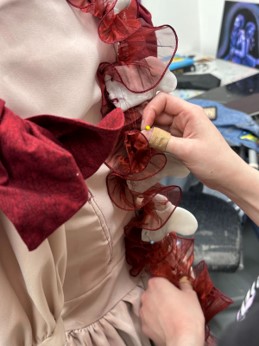
This creative research project: Hell Hath No Fury Like She: Reclaiming the Sacredness of Feminine Rage is a challenge between visual art and performance. It will include a portfolio of eight or nine original multimedia artworks (including paintings, sculptures, and wearables) that each take inspiration from a woman ascribed to historical or contemporary pop culture. These pieces will then be either created or interacted with in a documented performance (using film, photography, and writing) where I channel the source of aggression specific to each character. The final artwork will be the culmination of this study: my own confrontation and relationship with rage and how it has changed as a result of this project.
By exploring the dichotomy between the familiar act of creation associated with art and the violence of destruction, this body of work will push my boundaries as an artist. This will only be furthered by a mixture and exploration of materials. Shown above is a current experimentation using thermoplastic and fabric bodice pieces for a wearable sculpture.

As seen in the sketches attached, each piece will undergo a tailored process that considers both the creation of the art piece, and ideas for how it will transform through destructive performances. This particular example explores concept sketches for Lucille Sharpe (a character from Guillermo Del Toro’s Crimson Peak), who would be referenced in a wearable that will be torn or cut to reveal sculpted and hand painted underclothes underneath. As with Lucille, each character has been chosen specifically to include a broad spectrum of time periods and different sources of anger spanning theater, film, literature and art. The tentative list includes: Lady Macbeth, Medea, Carmilla, Medusa, Éowyn, Lucille Sharpe, Wanda Maximoff, and Barbie (with Bella Baxter as a potential candidate). The characters were chosen with two criteria in mind:
1. To provide a broad range of examples of female rage that may or may not be justified but provoke some familiarity with viewers.
2. To include characters I am genuinely passionate about and feel have been the victims of the male gaze or male writers.
Among my preparatory research readings include the writing’s of Julia Kristeva, “Approaching Abjection” and “Power of Horror: An Essay on Abjection,” and Barbara Creeds book, The Monstrous-Feminine. Kristeva in particular caused me to realize the true potential of feminine rage. It is not a trend, but the consequence society faces when denial and a desperation for agency drive the female identity to transform and find solace in abjection.
However, as the Spring semester concludes, I am prepping to expand past this research from written source material and feminist readings. For eight weeks in the summer I will be studying abroad and using the opportunity to visit conduct research in interviews, museums and archives, By studying physical artifacts in person and speaking with the creatives behind these works, I am curious to how outside interpretation, process, and perspective will affect my art (particularly the wearables). During and after the eight weeks abroad, I will then take my research and begin to create, interact with, and record my artwork, beginning with Lady Macbeth and Medea, and finishing with Barbie and art derived from my own rage.
As of now, that is all I have to share – signing off!
 HSF House Blogs