I am JP Romero, and I am majoring in biomedical engineering at Florida State University. I am from Panama City, Republic of Panama, and I have been in Tallahassee since the spring of 2022. I have been doing research as part of the Liu Research Group since the fall of 2023, where I have been gaining knowledge and experimenting with Microfluidic devices under the tutelage of Dr. Leo Liu.

The overall idea of the research I am conducting is to create devices that can conduct fluids such as blood to carry out experiments to aid in the diagnosis of arterial thrombosis. Cardiovascular diseases, such as heart attacks and strokes, are the major causes of death in the US, accounting for 1/3 of deaths annually and causing an excessive economic burden of 10 billion USD per day. Acute arterial thrombosis is a process that causes rapid occlusion of stenotic arteries (e.g., the coronary artery and the carotid artery) and subsequently heart attacks and strokes. Recently, researchers including the Liu Group have developed bio-functional microfluidic devices as diagnostic tools for arterial thrombosis. These devices allow fast diagnosis and screening of patients with high-risk arterial thrombosis, which has the potential to be used as point-of-care devices to guide clinical decisions.
Over the summer, I will be expanding on the current development of these devices, by introducing 3D printing techniques that will allow for more complex and high-level experimentation. The device called a chip, is made from a viscous polymer called PDMS that takes on the shape of a mold and solidifies under temperatures of 60-70°C. The chip is then taken out of the mold and covalently bonded to a glass slide using plasma cleaning equipment to allow for the flow of liquid. Current molds are made of resin and have been developed from an existing chip, which really limits the capabilities of expanding on new designs. The introduction of 3D printing would allow us to design whatever shape we believe is more suitable for any given experiment, allowing for more in-depth experimentation.
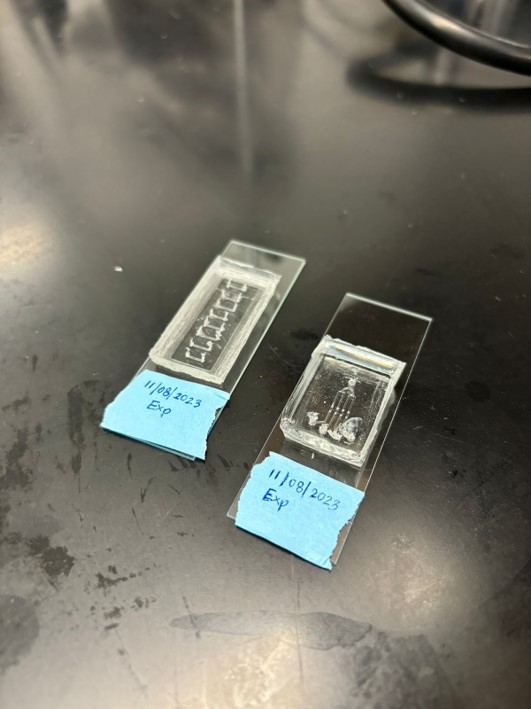
The issue lies in the fact that the 3D-printed molds result in a chip with a higher surface roughness. The higher surface roughness hinders the plasma cleaning process, which makes the bonding to the glass slide extremely hard. The solution I will be investigating is to add a polymer-based lubricant known as PFD to coat the surface of the 3-D printed mold to ensure a smoother surface that would enable more precise experiments. Once this is achieved, I will run thrombosis tests based on an in-house protocol (published previously by the Liu Group) using whole blood. I will quantify the occlusion time as an endpoint and analyze the variability and specificity of the results from the newly fabricated chip. I will compare the results with our previously published results.
With these results, I hope to publish a paper that will contribute to the diagnosis of cardiovascular diseases worldwide. I will keep working with Dr. Liu after the project is completed in hopes of continuing this process.
 HSF House Blogs