Hello everyone! My name is Jamila Guard and I am a 3rd year majoring in Behavioral Neuroscience. I am currently conducting research within Dr. Eckel’s research lab which studies dysregulated eating behaviors.
Watching the challenges faced by close friends and family struggling with eating disorders highlights the need to overcome unhealthy eating habits. This observation leads to the inference that biological and neural factors likely exert a substantial influence on the initiation and perpetuation of eating disorders. Fascinated by the complex biological roots of behavioral disorders, I decided to major in Behavioral Neuroscience. This interest led me to Dr. Eckel’s research, where she uses rodent models to study the intricate biological factors involved in eating disorders.

Emerging research indicates that medications commonly used to manage diabetes, specifically glucagon-like peptide-1 (GLP-1) receptor agonists, might offer benefits in mitigating binge eating observed in individuals with bulimic syndromes. Clinical investigations have demonstrated the effectiveness of the GLP-1 receptor agonist semaglutide (marketed as Ozempic®) in reducing overall food consumption, particularly the intake of appetizing foods. Emerging literature has also indicated that semaglutide may have an influence in brain areas that process motivation and reward. Collectively, these findings suggest that semaglutide could be efficacious in decreasing binge eating episodes.
My project this summer analyzes whether semaglutide can attenuate overconsumption of high fat diet (HFD) in a rodent model of binge eating. The treatment options currently available for bulimic syndromes are quite limited. Therefore, my research aims to explore GLP-1 as a potential new therapeutic target for reducing binge eating in individuals affected by bulimic syndromes. I hypothesize that the SEMA treatment will reduce intermittent, binge-like eating in female rats. I will also examine whether a history of binge-like eating alters the motivation to consume palatable food.

To model binge eating, female rats will have daily access to chow and receive intermittent access to high fat diet on “binge days”, occurring at 4-day intervals (INT group). The controls to this group, matched for body weight and age, will either receive chow daily (CHOW group) or continuous access to both chow and HFD (CONT group). The animals will also be separated to receive either daily SEMA or vehicle injections. Following assignment proceeds the dose escalation phase where animals within the SEMA group are gradually adapted to a SEMA dose of 70 mg/kg. Control groups will receive daily vehicle injections during this time. After dose escalation, animals will be exposed to their assigned diet groups for 12 days to produce 3 binge cycles while receiving daily SEMA or vehicle injections. After this binge eating phase, animals will be trained to consume a satiating meal over 5 days. On the 6th day, they will be given access to chocolate flavored ensure promptly after consuming the satiating meal. Body composition analyses will be measured through an ECHOMRI scanner. Body weight and food intake will be measured daily for the entire duration of the study. Group differences between food intake, body weight, dessert intake, and body composition will be assessed through ANOVA.
After completing my undergraduate studies, my aspiration is to pursue a doctoral degree in neuroscience, with a dissertation concentrating on addiction and the neural pathways that drive motivated behavior. Ultimately, my long-term objective is to secure a research position at a pharmaceutical company, where I can establish and lead my own laboratory. The focus of my current project on eating behaviors, particularly binge eating, which is frequently likened to addictive behavior, aligns with both my educational and future career aspirations.
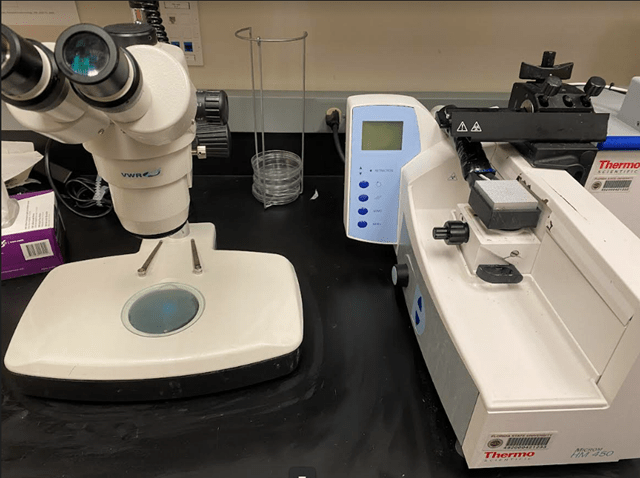
Figure 1 (top of post): The machines in this picture (left: high-powered microscope, right: microtome) are used for sectioning of brain tissue.
 HSF House Blogs
Hey Jamila, this sounds like a great project, especially given the growing craze over Ozempic and other semaglutide drugs. My knowledge is pretty limited on these medications, so I have a couple questions. You mentioned that binge eating is often linked to addictive behaviors, does this suggest that semaglutides could potentially be used for other addictions outside of binge eating? Is it already being used for this purpose in some cases?
LikeLike