My name is Clay Barczak, I am a student in the Bachelors of Fine Arts program at FSU who focuses on painting and drawing. My work places strong emphasis on engaging in historical practices of painting from a contemporary —somewhat digitized— perspective. Following graduation from FSU, I plan to continue on in the realm of academia in pursuit of a Masters of Fine Arts for an eventual career in teaching as I am extremely passionate about sharing my queer cultural knowledge and perspectives with future artists following me.

Throughout the Summer I will be working on a series of three 48” x 60” paintings that reimagine famous art historical compositions completed by those who could be considered old masters such as Francisco Goya, Carravaggio, and Jacques Louis-David. I will be working with oil paints to draw on practices of history painting whilst synthesizing this genre of painting with the contemporary application of collage to root this work in both the past and present. This foray into history painting will critically engage with societal systems of control and repressed desire through a synthetic hyper-queer lens.

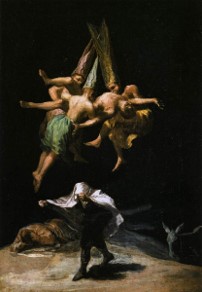
These reimaginings, consisting of queer and political imagery inserted into famous paintings that serve as either a statement on desire or political unrest, act as an assertion of queerness into the art historical canon in a more concise and clear way. Some of the specific works that I will be reworking are Francisco Goya’s 1798 painting, Witches Flight fig 2., which exists as a critique on the Catholic Church’s level of control and power over the general public in Spain during the 1700s (Tal, 2016), as well as Carravaggio’s 1599 still life, Basket of Fruit fig 3., which serves its purpose in this series as a more general representation of Caravaggio’s continuous exploration of desire and mortality (Menéndez-Antuña, 2018).
This clarification and explicitly queer nature of the series aligns with protest movements surrounding queer rights through the reclaiming of symbols of queer suppression like the use of the pink triangle by the ACT UP organization fig 4. during the AIDS epidemic onwards as a symbol of queer power while it was used as a symbol of queerness during the Holocaust (Kernahan, 2023). The purpose of this reimagining and clarifying of queerness in the canon is meant to root LGBTQIA+ identities in both the past and present while removing some of the ambiguity that is associated with artists that are rumored to be queer; ultimately, serving as a relinquishing of social constraints on the contexts of these works. This process of political-artistic relinquishment is meant to co-opt widely praised artists’ work to serve a more contemporary purpose extremely pertinent to the nationwide state of unrest surrounding LGBTQIA+ issues.

The final works will be exhibited locally as a series to spread awareness of queer identities existing in Northern Florida and the greater American South as a way of existence as protest in the face of disapproval by local governments. This queerification of heterocentric history establishes queer histories, which have otherwise been absent, in order to build narratives that challenge the “truth” of heterocentric society and builds towards a future that includes both hetero and spectral identity/sexuality. Through my artistic exploration, I hope to spark conversations, provoke thought, and contribute to the ongoing dialogue surrounding LGBTQIA+ representation and visibility in art and society.

References:
Kernahan, Louis Joe. “The Power of the Image and the Role of Social Representations in Iconographic Reproduction: The Pink Triangle.” Papers on Social Representations, 2023. https://www.psr.iscte-iul.pt/index.php/PSR/article/view/679.
Menéndez-Antuña, Luis. 2018. “Is Caravaggio a Queer Theologian? Paul’s Conversion on the Way to Damascus.” Critical Research on Religion 6 (2): 132–50. https://doi.org/10.1177/2050303218774865.
Muñoz, José Esteban. 2009. Cruising Utopia: The Then and There of Queer Futurity. NYU Press.
Tal, Guy. “Demonic Possession in the Enlightenment: Goya’s Flying Witches.” Magic, Ritual, and Witchcraft, December 28, 2016. https://muse.jhu.edu/pub/56/article/644095.
 HSF House Blogs