Serving at the Public Defender Services has allowed opportunities to build a community through sharing a collective interest in providing effective public legal representation to indigent defendants, constituents unable to afford private representation which are accused of the most serious and complex juvenile and adult crimes. Public Defenders are established to provide legal services to impoverished areas to serve the categorized as impoverished, underrepresented, and marginalized. Through investigative responsibilities, I interact with indigent defendants along with their associated low-income communities with a client-centered approach to providing effective representation. Through investigative field work, I have opportunities to experience the indigent defendant population by conducting client in-takes along with communicating with their families, friends, and neighborhoods in the District of Columbia and being able to conceptualize criminal charges along with their backgrounds. Examples include interviewing witnesses, family members, and victims, canvassing crime scenes along with their associated neighborhoods, collecting government evidence, serving subpoenas, and writing legal memorandums to record whereabouts and investigative activities, and testifying on behalf of defendants. In performing the investigative tasks which I was assigned, I learned more about the systematic and socio-economic issues confronted by surrounding communities. Investigations are efforts to establish timelines of whereabouts, collect discovery, build defense theories, and understand a client’s behavior.
Decades after the increase in crime in the 90s, the Southeast of the District of Columbia is experiencing a steady increase in violent crimes, such as homicide, sexual abuse, assault with a dangerous weapon, armed robbery, and carjacking. As part of the Criminal Law Intern Program, I often conduct field work in gentrified communities within the Southeast of the District of Columbia due to high concentrations of poverty, heightened violent crime rates, and economic displacement. Neighborhoods are historically-known to be avoided due to gun violence and high crime rates. A long history of tense relationships between residents of Black neighborhoods in the Southeast and the Metropolitan Police Department, fueled by instances of consistent police surveillance, harassment, and sometimes brutality, has brought conflict and disruption to local and national legislatures.
Through investigative tasks, my experiences have reshaped my concept of community by being able to work alongside adult and juvenile indigent defendants in the Southeast through client-centered relationships. By conducting client-intakes with indigent defendants, I have been able to intertextualize a criminal charge with the accused’s background, circumstances, and experiences. Using an analytical framework which promotes understanding of how meanings within human rights contexts are produced, materialized, and experienced by challenging preconceived generalizations and bias understandings reframes the human rights spectacle, such as a serious crime. Inquiring and understanding the positionality, context, and reasonings behind past experiences of indigent defendants presents potential dissonance between dominant perspectives held by the State. Due to accused crimes and harsh mandatory minimums, indigent defendants with “layered spaces” require significant time, effort, and care in understanding to provide effective representation. It is important to inquire about a person’s background, circumstances, and experiences to contextualize the incident, as indigent defendants have histories of medical and mental diagnosis, unstable housing and residence, and history of criminalization. When conducting client-intakes, I devised a series of inquiries to provide effective legal representation by contextualizing the incident and the charge at hand with a client’s circumstances and past experiences. Inquiries include identifying proper background information, support systems, residence, employment, education, past criminal, medical, and mental health history, the facts of the charge, and questions about obstacles encountered as a result of incarceration to advocate for their health and safety, innocence, and their release upon their behalf. Understanding how the intersectionality of race and class in a client’s upbringing highlights how a path towards incarceration was inevitable due to an unstable support system. It is important to self-reflect upon how self-evident rights, liberties, and freedoms are experienced differently in the experiences of marginalized groups due to socio-economic circumstances. Through a cohesive detailed narratives which archives the emotions, recollections, and traumas of the indigent defendant, illustrating how a client’s upbringing has affected a path to incarceration is illustrated through testimonies. Narrating misconceptions about an accused crime positions the jury to be witnesses to the social inequalities which influences the experiences and circumstances of indigent defendants. It begins and ends with the Public Defender as the witness who will first employ patience, rhetorical listening, and support in providing the utmost and attention speaking from a position of knowledge and credibility. In a court of law, however, unbounded legal standards further constraints testifying and witnessing. Defendants are not only exposed to the physical and mental trauma by illustrating detailed events, but will be countered with resistance by the State through cross-examination or presentation of contradictory evidence. In turn, the government attempts to conceal the relationships between power, privilege, and resources in determining the experiences of indigent defendants.
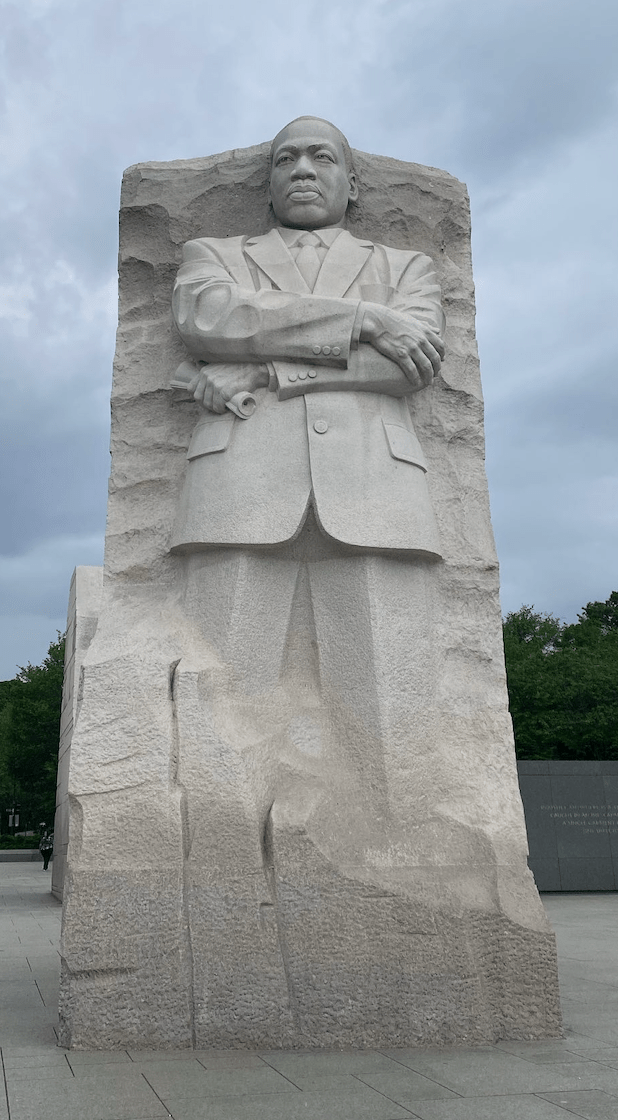
I have attached a few of my favorite photographs at influential historic sites: a monument of Dr. Martin Luther King Jr. at the National Mall, a quilt of Harriet Tubman at the African American History and Culture Museum, a portrait of Barack Obama at the National Portrait Gallery, and the Smithsonian Museum of the American Indian.


 HSF House Blogs