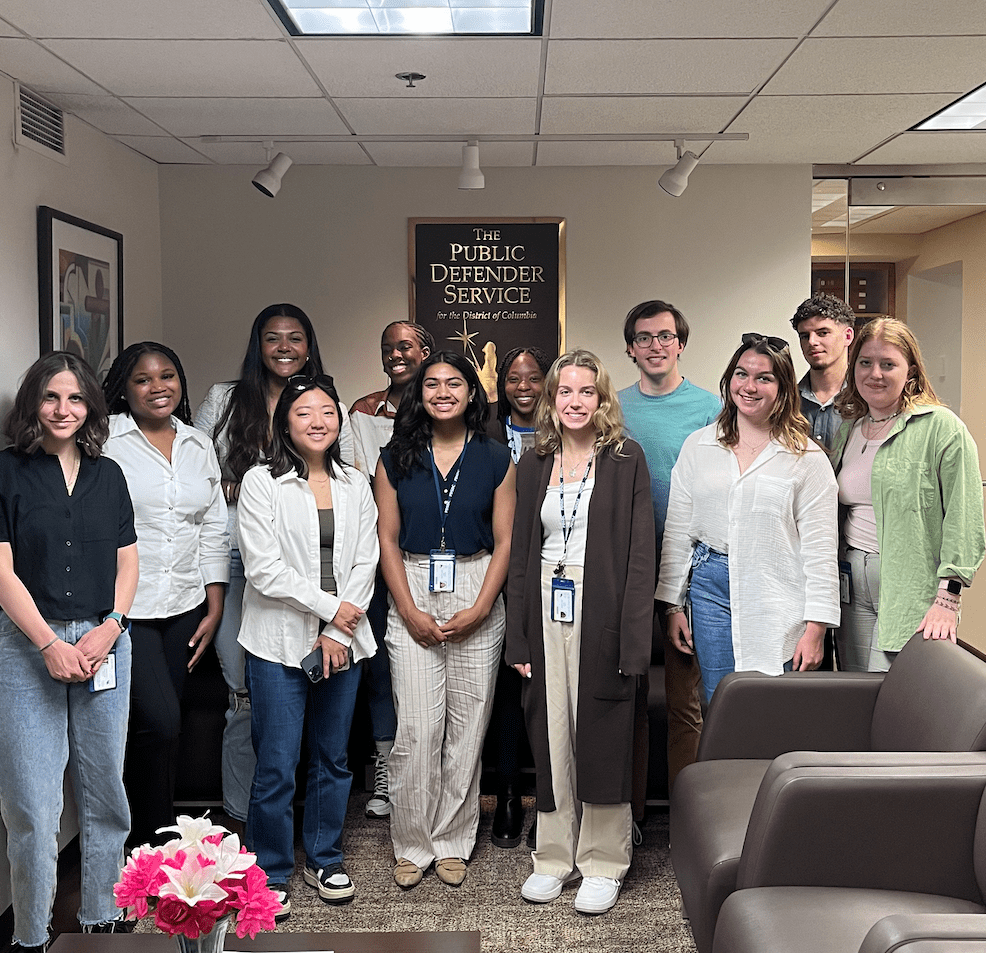
“Solidarity” is apparent between the Public Defender Services and the indigent defendants represented in a court of law, along with their related neighborhoods. Throughout the past few weeks, I have experienced a sense of belonging with attorneys, investigators, law clerks, investigative interns, and support personnel at the Public Defender Services because of sharing common interests and goals. Supporting staff holds similar universal values, interests, standards, and sympathies for human rights, social justice, and providing effective public legal representation to the communities of the District of Columbia in which we serve. The Public Defender Services is a community empowered by the indigent defendants which deserve an equal right to be heard, seen, freed, acquitted, rehabilitated, and redeemed. Using generic litigation skills and investigative practices to provide complete, quality representation in the most serious and complex crimes, adequate care is provided. Whether it is an arrest, conviction, or incarceration, the Public Defender Services provides useful information to individuals who have been convicted, are being held in correctional facilities, to assist and monitor their conditions of incarceration. Leading systematic efforts to revise public representation, the Public Defender Services includes a variety of legal practice and support areas, including the Trial Division, Special Litigation Division, Mental Health Division, Parole Division, Community Defenders Division, and Civil Division. Since the Public Defender Services is allocated funding by Congress, the financial support helps recruit experienced legal personnel who are committed to providing the information and services towards community rehabilitation in an effort to restore lives, rebuild families, and rectify justice. With hundreds of residents seeking legal advice concerning their criminal grievances, legal representation services are competent, conscientious, and meet the physical, mental, and emotional issues of indigent defendants.
Beginning with a mandatory two-week training process, supportive personnel provided assistance with the integration process with resourceful materials about eyewitness identification procedures, defense theories, the collection, preservation, and documentation of evidence, differentiating surveillance footage, crime scene investigation, writing detailed investigative memorandums, proper interviewing techniques, and how to navigate the District of Columbia. With access to mentorship, legal resources, and continuous beneficial training to obtain necessary outcomes in criminal cases, I was prepared to effectively advocate, represent, and support indigent defendants and uphold their civil rights. Throughout training, collective discussions with thirteen like-minded undergraduate students were held, which displayed characteristics such as kindness, respect, compassion, tolerance, and empathy towards the indigent defendant population. By learning about various backgrounds, schools, interests, degrees, and future career paths of investigative interns, I developed a community which shared a mutual recognition to fulfill, commit, and promote high-quality to meet collective objectives of the Public Defender Service. My cohort of investigative interns shared a collective passion towards assisting indigent defendants by perceiving, acknowledging, and understanding the importance of public legal representation. I complete a majority of desk work at the office to be able to communicate and collaborate in-person with attorneys, investigators, law clerks, investigative interns, and other supportive personnel when assistance is necessary.
The specific issues in which “solidarity” appeared most evident are instances of collaboration, communication, and cooperation from personnel such as attorneys, investigators, law clerks, and investigative interns with specific investigative tasks which may require more assistance to conduct. Since the internship demanded attention, time, and effort, assigned pairs of investigative interns had developed interdependence between one another to complete difficult, serious, complex field tasks. Previously having established a community of like-minded personnel, my assigned team provided the support necessary to overcome legal adversaries which are present on a daily basis within a fast-paced public legal office. During field investigative work, it is important to build mutual relationships with investigative interns due to the serious nature of the internship. As I spend a majority of investigative resources assisting indigent defendants in Southeast, District of Columbia, I always bring another investigative intern as a safety precaution and to have another perspective about the investigations which transpire. It is best to canvas crime scenes with another investigative intern in case possible exculpatory evidence is found, potential witness interviewed, and to have detailed descriptions of events for investigative memorandums. Time-sensitive investigative tasks which may require multiple investigative interns include preparing trial exhibits, interviewing a witness, and analyzing time-sensitive discovery materials.
 HSF House Blogs