By Reagan Claggett, University of Hawaiʻi at Mānoa
My mentored research project abroad turned out to be far more transformative than I ever imagined. Beyond technical skills, it opened the door to writing better scientific proposals, navigating professional interviews with confidence, and presenting data in meaningful ways. Stepping into a field I’ve been passionate about for years felt exhilarating, and at times intimidating, but moments outside my comfort zone became the most rewarding. Connecting with people from diverse cultures and backgrounds, hearing their stories, and finding common ground taught me lessons I could never have learned in a classroom. Today, I carry not only stronger research skills but also a clearer sense of purpose and the values I want to uphold.
I am certain of my ability to work under ethical guidelines and to navigate the process of starting a research project, areas that were completely new to me before this experience. Collecting data and discerning what is most relevant became easy, but I quickly realized that the true value of research lies not only in the results but in sharing them in ways that are widely accessible and impactful. Presenting my findings at a professional symposium, receiving audience feedback, and refining my communication skills taught me how to engage others effectively. I now approach presentations with a greater sense of clarity and purpose, confident that my next opportunity will be even more influential.
Engaging in research across global contexts has also expanded my perspective on complex issues. Scientific collaboration requires empathy, flexibility, and clear communication, and the chance to work closely with people from varied backgrounds was invaluable. Learning to build rapport, navigate cultural differences, and appreciate multiple viewpoints will be essential for my future projects. Doing this through my university also gave me the opportunity to meet and build relationships with my peers as we navigated this experience together.

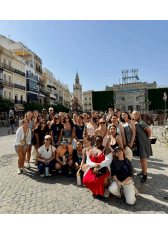
Me and my peers at the International College of Seville.
As part of my research, I conducted numerous interviews with residents of Seville. I was continually inspired by the openness and willingness of each participant to share their experiences. Seville’s cultural emphasis on conservation and traditional building designs like shaded patios and tile floors illustrate how local values and heritage also guide sustainable practices. Recognizing these connections helped me appreciate the role of culture in shaping environmental behavior. Everyone I spoke with cared deeply about the environment and sought to make a difference in their communities, though many were unsure where to start. Participants described adjustments to their daily routines and resource use, yet a recurring theme emerged: the gap between climate awareness and sustained action. Economic constraints, policy delays, and uncertainty often hindered their efforts, highlighting a need for more empathy, education, and systemic support alongside individual responsibility.

Shade structures like shown here in downtown Seville provide natural cooling and reduce urban heat, reflecting the city’s commitment to sustainable climate adaptations.
A sustainable future in Seville, and beyond, requires aligning community values with policy enforcement, education, and long-term investments. Empowered individuals and accountable systems must work together to protect both people and the environment. The most important takeaway from my project is that small, consistent behavior changes in individuals’ lives do matter. When communities act collectively, meaningful change becomes possible.
In my future endeavors, I intend to advocate for transparent, comprehensive communication between policy makers and communities while continuing to encourage community-driven conservation. This opportunity strengthened my passion for traveling, building connections with people, and working toward climate solutions. Through this project, I was able to reflect my deep commitment to sustainability and community-driven action while exploring how cultural and social factors might impact these practices. The experience made me feel that I could truly make a difference and reaffirmed my dedication to conservation. Although the journey was sometimes frustrating and challenging, it was ultimately fulfilling and exciting and I am deeply grateful for the opportunity.
My research builds on existing knowledge in sustainability and highlights the significant role of community action. I identified strategies that can be applied beyond Seville, and I plan to incorporate them in my work with the Surfrider Foundation as a UH Mānoa executive board member, as well as in my own initiatives.

A flamenco dancer performing in Seville.
 HSF House Blogs