By Charlotte Stuart-Tilley, Florida State University
In my last blog post, I introduced myself and my research, which I will complete in Accra, Ghana. I will be working with Fulbe people to understand how they conceptualize human rights, marginalization, and identity. My work thus far has mainly been about preparing to leave for Ghana, including navigating research ethics requirements and applying for a visa.
The latter has been an enormous headache. When I mailed the flimsy cardboard envelope with myactual passport and a dozen different copies of various sensitive documents, I almost fainted in the FedEx lobby from the stress. I am not kidding–I had to sit down and drink some water! I checked my status daily through the online visa application portal, which did not update to indicate it was received or any progress had been made. After weeks of no confirmation or support from the Ghanaian embassy, I suspected something was wrong and hoped that it would be resolved quickly as I approached my departure day. On Memorial Day, I received a notification from a news outlet about an emerging fraud investigation into the Ghanaian embassy in Washington D.C., effectively closing it down for at least a few days. I had planned to leave on June 1st, but without a visa or passport, I cannot enter Ghana or any other foreign country. Now, I am waiting patiently for my visa and scrambling to adjust my research timelines to accommodate.
On the bright side, shifting my departure date has given me more time to prepare for my research and to leave Tallahassee. Following a series of family-related emergencies, I feel like I have fallen behind on things that I wanted to complete before I started my research, so I am grateful for the extra time. Still, I cannot wait to be in Accra and find the whole process very frustrating.
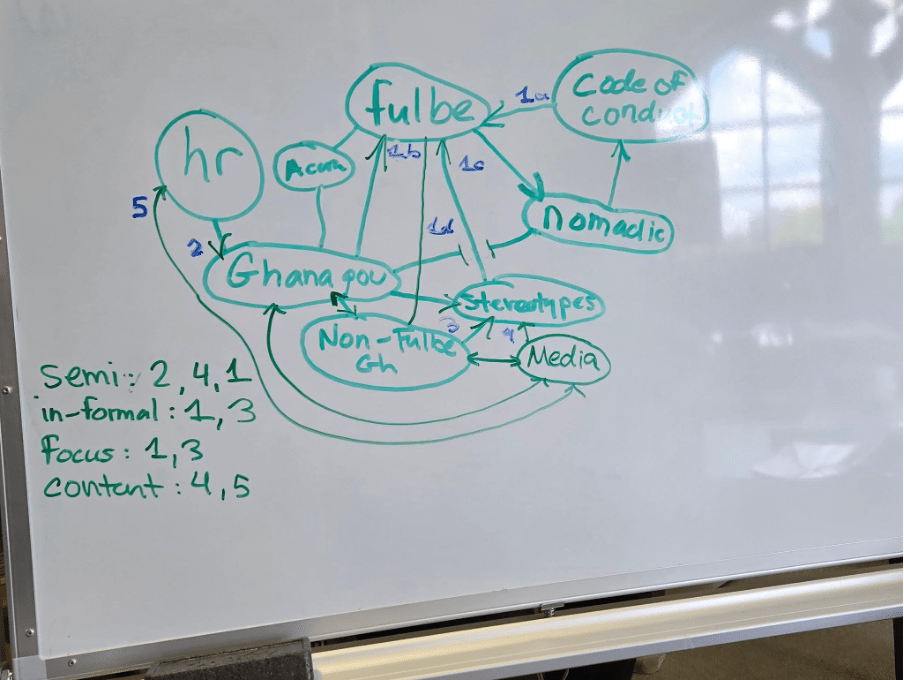
The photo features some of my brainstorming on a white board, which might help you understand my thought process while planning my research approach! My advisor, Dr. Joseph Hellweg, has been especially helpful during this stage of research and showed me how to brainstorm and connect my ideas effectively. I have done more reading than I anticipated, which has given me new perspectives on my research and how I want to do it. In particular, I have been reading a book called Writing Ethnographic Fieldnotes (1995), by Robert Emerson, Rachel Fretz, and Linda Shaw, which describes the kinds of questions and methods that a good ethnographer uses. Lately, I have been reflecting on the importance of details and specifics when describing people and situations as an ethnographer. When I’m in the field, I must do my best to protect the privacy and safety of the people I am working with while accurately capturing details about my interactions with them. Even the sights, sounds, and smells can help me to better understand a situation or an idea! Dr. Hellweg has extensive ethnographic experience and his undergraduate advisor, Dr. Paul Riesman, worked as an ethnographer with Fulbe people in Mali several decades ago. Dr. Hellweg emphasized to me that the best thing an ethnographer can do, rather than just stay as an observer, is to try to participate in daily life. Dr. Riesman’s ethnographies engage the reader because he describes all of the details from within the situation, as a participant observer. Of course, I will always be an outsider. But the more that I am able to put myself in the shoes of the people I’m working with, the better I may become at understanding their perspectives.
My project aims to understand Fulbe perspectives (and conceptualizations of ideas), so I have taken this advice to heart. I am so excited to begin my work in Accra and hope that the embassy issues my visa soon!
 HSF House Blogs