By Lee Garcia, Florida State University
I’m back in the United States and so excited to announce that Akkadian has begun in earnest! Dr. Levenson and I were able to meet for the first time since our respective returns to the United States and iron out a game plan for what the rest of this summer will look like. I met some incredible people in Italy and got to take part in a wonderful dig, but I’m so happy to be starting on the language portion of this project in earnest.
The first order of business is to produce a preliminary annotated bibliography. This will be the starting point for both my Honors in the Major sources and the literature review that I will be producing as a part of this project. I’ve already done the hard part of finding and reading many of them so fortunately this step is much easier. It’s just a matter of compiling what I’ve found and submitting them for feedback. I’m fortunate to be familiar with the field and to have interacted with many of these sources previously. I’ll also continue researching for the next few weeks and hone in on the best possible sources to carry into the Fall semester.
In addition to the bibliography we’ve really begun studying the language. My goal for the next week is to work through the first seven units of Complete Babylonian (our preliminary textbook for Akkadian). These cover methodology, pronunciation, transliteration–in this case the process of converting cuneiform to Latin script–roots, and an introduction to paradigms. While it sounds like a lot I’m fortunate to have studied Arabic and Syriac: both of which, like Akkadian, are Semitic languages and thus very similar.
Unlike Arabic and Syriac, however, Akkadian cuneiform is syllabic. Rather than standing for an individual letter, each sign generally represents a consonant/vowel pair. As a result, many Akkadian texts are made accessible through transliteration rather than being read in the initial cuneiform. I am interested in learning the signs, but because this is something I’ve never encountered before, I’m not entirely sure how to go about memorizing them. I’ll start with flashcards of the signs relevant to the vocabulary in these first seven units and see how it goes! I also plan to look into how other learners of syllabic writing systems (such as Chinese) generally go about this process and take tips from there. Perhaps the trick is to go old-school and write on clay!
Unfortunately this isn’t the only hurdle I’ve encountered so far. I’ve continued to have some issues with my laptop, which has made the bibliography more difficult, and I’m quickly realizing just how little time is left in the summer. I need to be very strict with myself and push for lots of consistent studying over the next few weeks. Language learning can’t be left for the last minute and should be practiced daily, so I’m working on developing a routine that’ll keep me learning throughout each week. However, an important part of any process like this is staying flexible, which I can certainly do! By the time Dr. Levenson and I reconvene I’ll have a better sense of how to approach this portion of the project.
I’m also pleased to report that Akkadian thus far looks to be similar to both Arabic and Syriac in a lot of important ways and the textbooks we’re using are also very clear and provide a lot of helpful resources. Huehnergard’s A Grammar of Akkadian helpfully lists cognates from other Semitic languages, which was a welcome surprise! I’m excited to see if the languages share major structural similarities, and so happy to finally chase this dream. Clay tablet pictures to follow?

The view from our final day in Italy! My friends and I took a day trip out to Bracciano, a lake town near Rome.
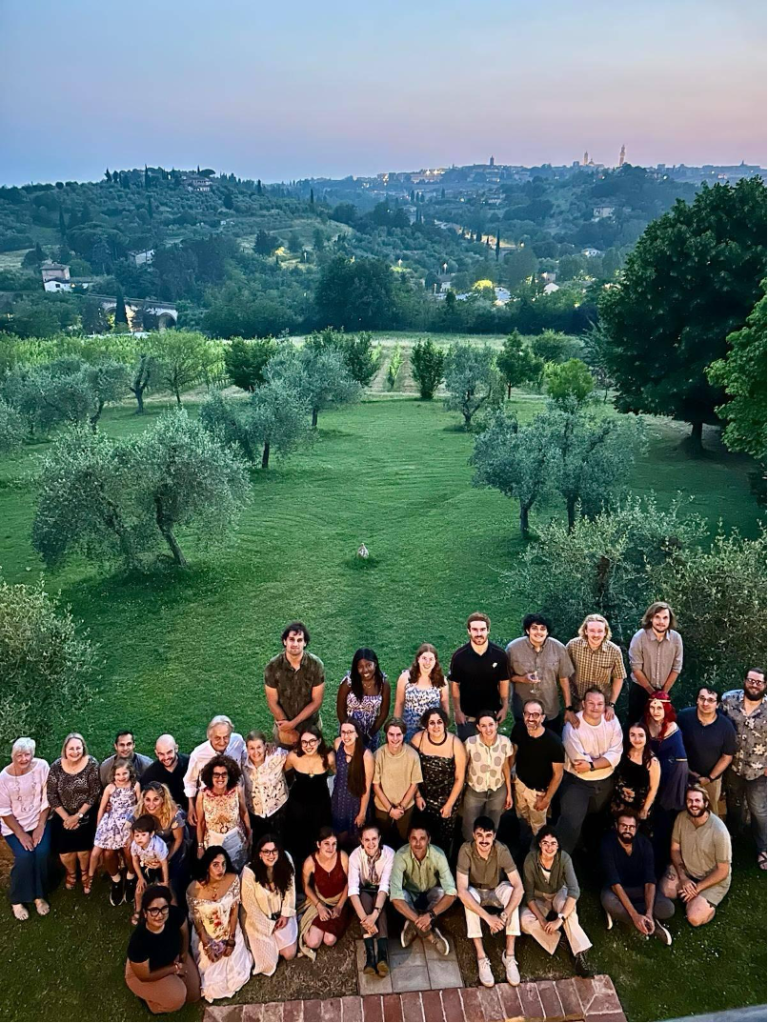
The Cetamura 2025 crew!
 HSF House Blogs