By Oscar Linehan-Siu
William & Mary
My name is Oscar Linehan-Siu. I am a history and European studies major at William & Mary, raised in Arlington, Virginia, currently working on my honors thesis in history. I started taking German classes at the beginning of my school year on a whim (I thought it was somewhat embarrassing to be monolingual, and I had an Austrian friend in high school), but language learning can quickly develop into a passionate long-term love/hate affair, as in my case. I can now confidently say that I know German (well enough to work on a project that relies heavily on primary sources in the language), and a recent trip to Paris has inspired me to one day add French to my repertoire.
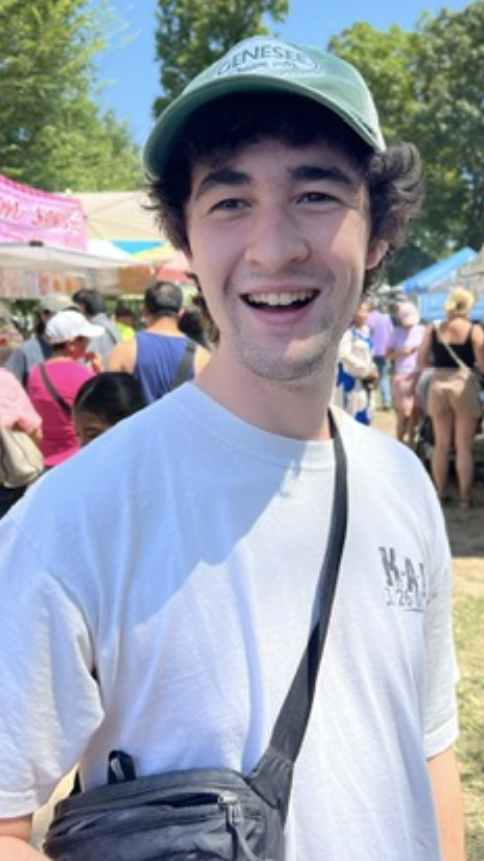
In my free time I run, watch movies, read, and enjoy the company of my friends on the William & Mary rowing team, where I have rowed, coxed, and served on the executive board as both treasurer and head of team fundraising. Despite the Chickahominy River’s fickle current and often unrowable waters, I have yet to row on a course with such spectacular birds (hawks, herons, and eagles are a common sight), and I would never exchange it for any other body of water. In my spare time, I try to catch up on the vast sum of theoretical literature I have not yet read. My “want to read” list expands far faster than the rate at which I finish books, and it recently dawned on me for the umpteenth time that there are too many great books and simply not enough time to finish them all.
To this end, I am analyzing sources accessible in the Nationalbibliothek and the Koloniale Sammlungen at the Goethe-Universität Bibliothek, both in Frankfurt am Main, Germany. The Nationalbibliothek provides access to every book published in Germany since 1913, making it a fantastic resource for secondary source collection. The Goethe-Universität library holds an impressive collection of documents from the Deutsche Kolonialgesellschaft (German Colonial Society), the most important group advocating for sustained colonial expansion and exploitation in Imperial Germany. With this large pool of sources, I will analyze German rhetoric regarding Africans from 1880-1914. Especially pertinent for my thesis are any comparisons between the German settler-colonial project in Southwest Africa (today Namibia) and previous and contemporaneous settler colonial projects, in particular the United States. In order to make the most of my time in Frankfurt, I will be focusing on the sources accessible only on the library network, some of which I have been able to download onto a USB drive. In addition, I will be spending a week researching in Hamburg, the historical epicenter of German colonial trade and the site of many historical buildings and museums relevant to the topic.
While I am in Europe, I also plan to spend a weekend in Berlin with my school’s summer semester German program at the Freie Universität Berlin, led by Professor Jennifer Gülly. Last year, I participated in this same program, and through it, I became a confident German speaker. This time, in addition to researching for my thesis, I hope to surpass the level of spoken German I obtained last year. Although my research will not leave me with much time, I will carve out the time to meet people and create connections with scholars, professionals, retirees, students, and other strangers who I might happen upon. While there is no widely accepted linguistic definition of fluency, I hope to achieve something close to the colloquial understanding of that concept by the time I return to the United States.
I would like to thank the Tyler Fellowship Center for their interest in my studies and granting me the opportunity to complete my research in Germany. I look forward to continuing my research abroad and completing this phase of my thesis upon my return to Williamsburg.
 HSF House Blogs